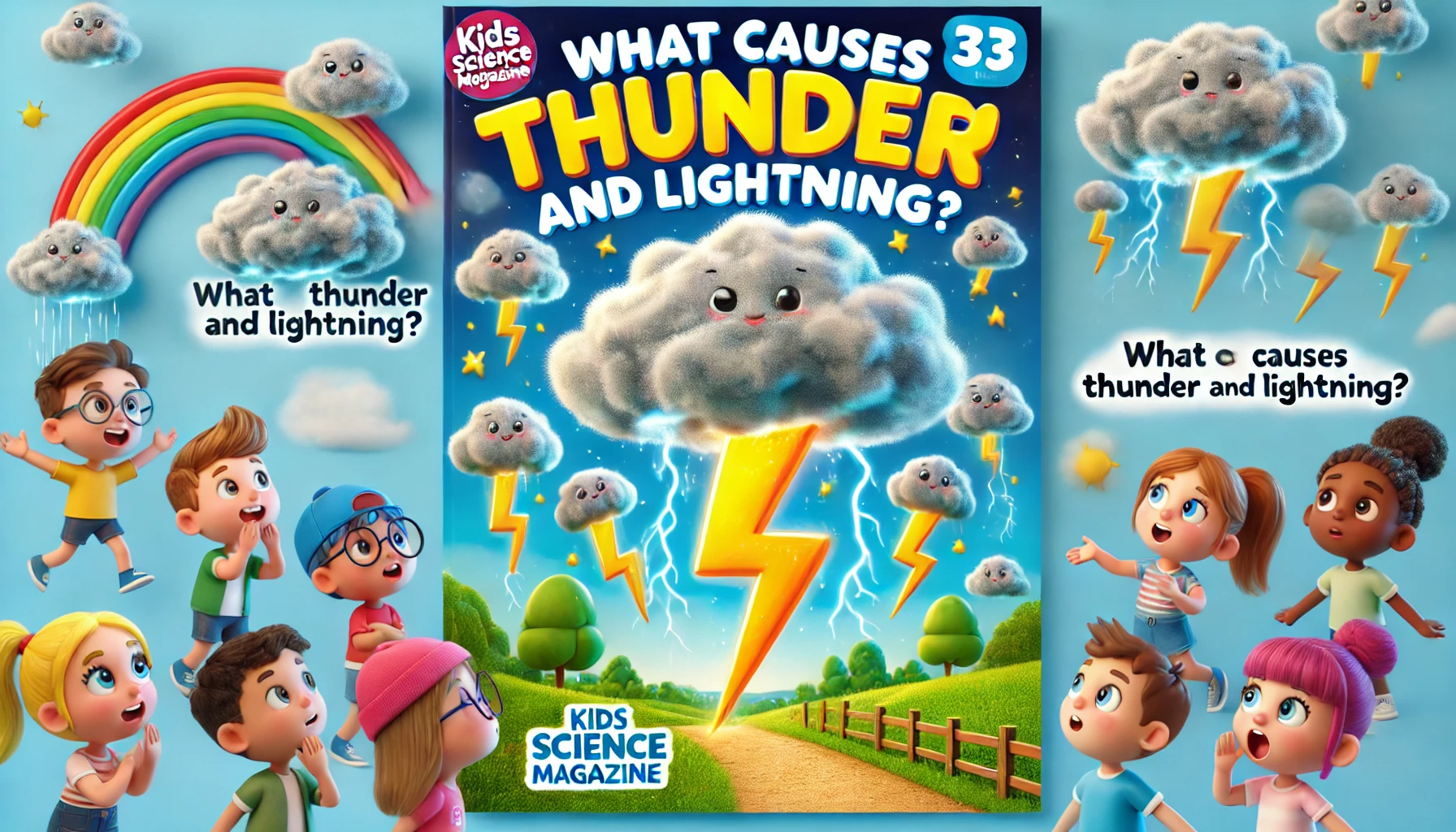
Hey there, little weather explorers! Have you ever been amazed (or maybe a little scared) when you see bright lightning flashing in the sky, followed by a big rumbling sound? 🌩️ This is thunder and lightning, and it’s one of nature’s coolest (and loudest!) tricks! But what exactly causes it? Let’s dive into the exciting world of storms and learn all about thunder and lightning.
The Power of Lightning ⚡
When a thunderstorm rolls in, the sky fills with big, dark clouds. These clouds are made up of tiny droplets of water and little ice crystals that rub against each other as they move. This rubbing creates something called static electricity, kind of like when you rub a balloon on your hair and it makes your hair stick up!
As the electricity builds up, it creates a strong electric charge in the cloud. The charge gets so powerful that it shoots out from the cloud in a big burst of energy — and that’s the lightning! ⚡ The lightning travels fast, lighting up the sky as it searches for something to connect with, like the ground, another cloud, or even the same cloud!
Boom! Here Comes Thunder 🌪️
Once lightning flashes, it heats up the air around it to super-high temperatures, even hotter than the sun for a split second! When the air gets this hot, it expands very quickly. Then, it cools down and squishes back together, creating a loud sound wave. That sound wave is what we call thunder. 🌩️
If you’ve ever noticed that lightning flashes before you hear the thunder, that’s because light travels faster than sound. So even though lightning and thunder happen at the same time, we see the flash first and hear the boom a little later.
Why Thunderstorms Happen 🌧️
Thunderstorms usually form on hot, humid days when warm air rises from the ground and meets cold air higher up. This creates strong winds, and as the warm air cools and turns into clouds, it eventually leads to the formation of thunderclouds, known as cumulonimbus clouds. These clouds are tall, dark, and full of energy, making them perfect for creating thunder and lightning.
Staying Safe During a Thunderstorm 🛡️
When there’s a thunderstorm, it’s always safest to stay indoors. Lightning likes to strike tall objects, like trees, poles, and even people who are out in the open. So if you’re inside, you’ll be safe and can enjoy the light and sound show from a cozy spot.
Fun Fact: Counting to Measure Distance! 🌩️
If you want to know how far away lightning is, you can use a cool trick! Right after you see a lightning flash, start counting the seconds until you hear thunder. For every five seconds you count, the lightning is about one mile away. So if you count to ten, the lightning is two miles away!
🌩️ Do You Know? Fun Facts About Thunder and Lightning 🌩️
- Lightning is Faster Than a Cheetah! 🐆
Did you know lightning travels at a speed of about 270,000 miles per hour? That’s over 400 times faster than the world’s fastest animal, the cheetah! - Thunder Can’t Hurt You, But Lightning Can! ⚡
Thunder is just a loud sound, so it can’t hurt you. But lightning is powerful and can strike from miles away, so it’s best to stay indoors during a storm! - The Earth Gets Zapped Often! 🌎
Around the world, there are about 100 lightning strikes every second. That’s 8.6 million strikes every single day! - Lightning Can Be Hotter Than the Sun! ☀️
The temperature of lightning can reach up to 50,000 degrees Fahrenheit — that’s five times hotter than the surface of the sun! - Counting Seconds Between Lightning and Thunder Can Tell You the Distance! ⏱️
Count the seconds after a lightning flash until you hear thunder, then divide by 5 to find out how many miles away the lightning is! - Lightning Doesn’t Only Happen on Earth! 🪐
Lightning has been observed on planets like Jupiter and Saturn, too! Scientists think it happens in their storms, just like on Earth. - You Can Have Thunder Without Lightning… Sometimes! 🌧️
Technically, thunder comes from lightning. But when a storm is far enough away, you might hear the thunder without seeing the flash! - Lightning Can Strike the Same Place Twice! ⛪
Contrary to popular belief, lightning often strikes the same tall structures, like the Empire State Building, multiple times during a single storm! - Some People Have Been Struck by Lightning… Multiple Times! 😲
There’s a man named Roy Sullivan who was struck by lightning seven times in his life — and he survived each one! - A Special Kind of Lightning Exists: Ball Lightning! ⚽
Rarely, a round, glowing ball of lightning has been seen floating through the air. Scientists are still puzzled by this unusual type of lightning!
Quiz: How Well Do You Know Thunder and Lightning?
- True or False: Thunder can hurt you if it’s loud enough.
- A) True
- B) False
- What causes thunder?
- A) Raindrops hitting the ground
- B) Clouds bumping into each other
- C) Lightning heating the air
- How fast does lightning travel?
- A) 60 miles per hour
- B) 270,000 miles per hour
- C) 100 miles per hour
- If you see lightning and hear thunder 10 seconds later, how far away is the storm?
- A) 2 miles
- B) 5 miles
- C) 10 miles
Puzzle: Lightning Maze
Help the lightning bolt travel through a winding maze to reach the ground! Kids can navigate the bolt through twists and turns, learning about lightning’s unpredictable paths.
Poll: What Part of a Storm Do You Find the Most Exciting?
- The flash of lightning ⚡
- The rumble of thunder 🌩️
- The dark, stormy clouds 🌫️
- Raindrops falling ☔
Matching Game: Match the Weather Terms
- Lightning – (Your Choices: Flash of light, Sound of thunder, Raindrops)
- Thunder – (Your Choices: Flash of light, Sound of thunder, Raindrops)
- Storm Clouds – (Your Choices: Dark clouds, Wind, Clear sky)
- Raindrops – (Your Choices: Flash of light, Sound of thunder, Water falling from the sky)
Word Scramble: Unscramble the Weather Words
- HRDTNEU (Hint: The sound that comes after lightning!)
- IGLITNHGN (Hint: A flash in the sky during a storm)
- RDPSOTM (Hint: A rainy, windy weather event)
- DLOUC (Hint: They form in the sky and bring rain)
Recap: The Science of Thunder and Lightning
- Lightning is caused by a build-up of static electricity in storm clouds.
- Thunder is the sound created when lightning heats the air, causing it to expand and then shrink back.
- Thunderstorms need warm, humid air to form, which often happens on hot days.
So the next time you hear that rumble and see that flash in the sky, remember that you’re witnessing the incredible science of storms!

The Kids Science Magazine Editorial Team brings together nearly a decade of hands-on experience in electronics engineering, IoT systems, and embedded technology — combined with a deep passion for making complex science genuinely exciting for young minds. Our writers have worked across core electronics testing and real-world technology development, giving every science mystery article a foundation in actual engineering thinking rather than surface-level storytelling. We believe every child deserves access to mind-blowing science — explained clearly, honestly, and in a way that makes them lean forward and ask “but wait, WHY?” Every mystery published on this site is thoroughly researched, fact-checked against credible scientific sources, and written to spark curiosity in kids aged 8–14 across the USA, UK, Canada, Australia & Others across the Globe. New mystery every Friday — because science never runs out of surprises.