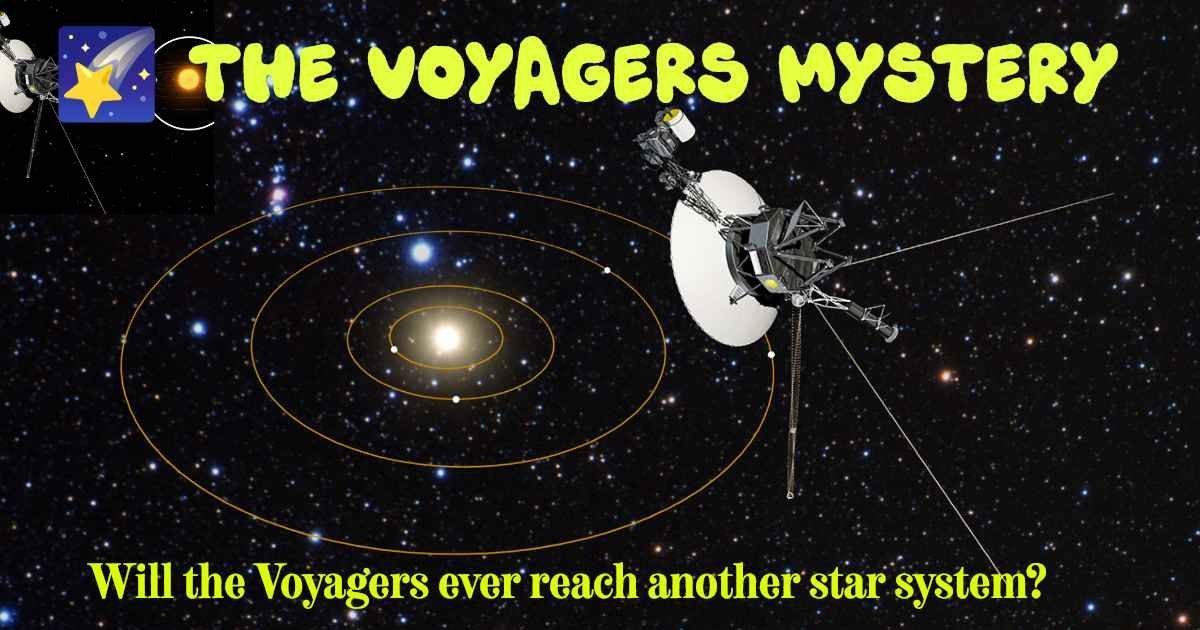
🌠 Where Are the Voyager Spacecraft Going?
A Journey That Never Ends: How humanity's farthest robotic travelers sailed past the planets and entered interstellar space.
The Space Mystery That’s Still Unfolding…
🚀 A Journey That Never Ends…
Over 40 years ago—before smartphones, Wi-Fi, or even modern internet existed—NASA launched two special space travelers: Voyager 1 and Voyager 2. These weren’t astronauts or rovers… they were robotic spacecraft sent on the most daring planetary grand tour in human history.
Their mission?To explore the outer gas giants and then keep flying… forever.
And guess what?They’re still cruising through deep space.
Where are they headed? Will they ever reach another star, or just drift into the cold, dark unknown? Let’s unlock this space mystery!
🌍 Meet the Voyagers!
Both probes were designed to explore the outer giant planets—Jupiter, Saturn, Uranus, and Neptune. They sent back breathtaking images of Jupiter's Great Red Spot, active sulfur volcanoes on moon Io, the intricate icy rings of Saturn, and geysers erupting on Neptune's moon Triton. But once their planetary flybys concluded, they kept coasting onward into the cosmic deep.
🧭 Where Are They Now?
Today, Voyager 1 is the farthest human-made object from Earth—over 15 billion miles (over 24 billion kilometers) away, with Voyager 2 traveling along a southern trajectory not far behind.
Both spacecraft have crossed the heliopause into interstellar space—the vast expanse between the stars beyond our Sun's solar wind bubble.
🪐 Stars Are Really, Really Far Away…
Voyager 1 is traveling at roughly 61,000 kilometers per hour (around 38,000 miles per hour). Yet space is so unimaginably vast that it will take about 40,000 years just to pass within 1.6 light-years of the red dwarf star Gliese 445 in the constellation Camelopardalis, while Voyager 2 will pass near Ross 248.
🎵 The Golden Record: A Message for the Cosmos
Each Voyager carries a 12-inch gold-plated copper phonograph record encased in an aluminum protective jacket:
It serves as a cosmic time capsule. Will an extraterrestrial civilization ever intercept it billions of years from now?
🧠 Did You Know?
❓ Quick Quiz Review
✨ Did You Know?
📖 Science Word
Heliopause
/HEE-lee-oh-pawz/The theoretical boundary where the outward pressure of the solar wind balances against the inward pressure of interstellar cosmic particle winds.
🔤 Word Scramble
Test Yourself!
Question 1 of 4
What is the primary function of the Golden Record mounted onto each Voyager probe?
Quick Poll
What content on the Voyager Golden Record do you think is the most meaningful to send into deep space?
How fun was this article?