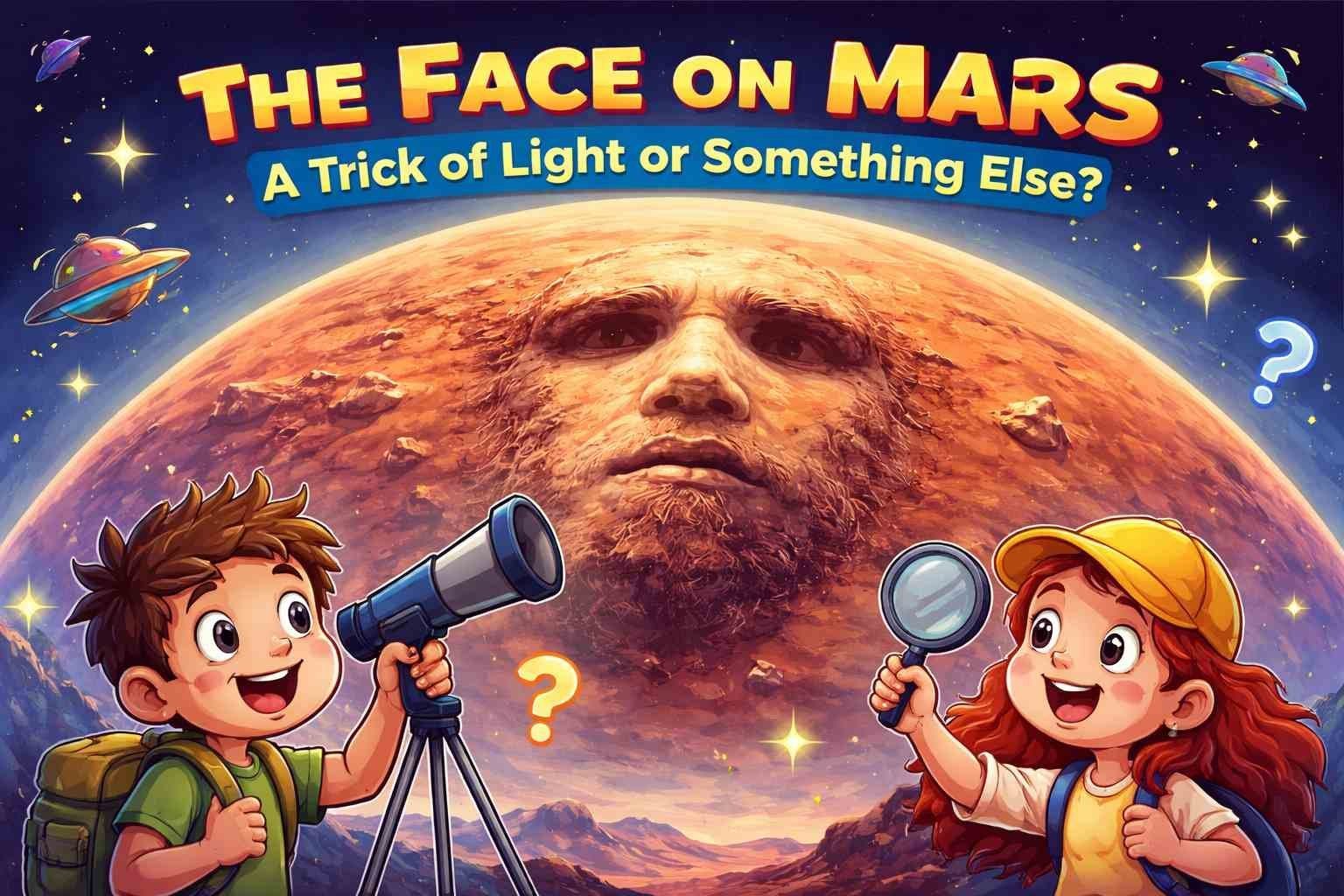
🛸 The Face on Mars Mystery Explained for Kids
Trick of Light or Alien Secret? How shadows, camera pixels, and human psychology turned a Martian hill into a legendary cosmic riddle.
Photos of Mars once showed a giant face that shocked the world. Was it an alien monument or a shadow trick? Discover the truth behind the Face on Mars in this fun science mystery for kids!
🔍 A Face Staring from Another World?
Imagine looking at photos from another planet… and suddenly seeing a giant face staring back at you 😲That’s exactly what happened when scientists first shared images of Mars showing what looked like eyes, a nose, and a mouth carved into the rocky surface.
Was it a secret alien statue? A message left by an ancient civilization? Or just a sneaky shadow playing tricks on our brains? Welcome to one of the most famous space mysteries ever — The Face on Mars!
🧭 Background: How the Mystery Began
In 1976, NASA's Viking 1 orbiter was circling Mars, mapping prospective landing sites for Viking 2. While passing over the northern desert region called Cydonia, it snapped an image labeled frame 35A72.
Instead of just flat dust and craters, the photograph appeared to show:
NASA scientists explained at a press conference that the feature was simply a natural geological mesa illuminated by a low-angle Martian sun, creating optical shadow illusions. But once the public saw the photograph, speculation erupted worldwide.
🧠 Why Does It Look So Real?
The human brain is an evolutionary pattern-detecting machine. From infancy, humans are wired to recognize human faces instantly for communication and survival.
This cognitive tendency is called pareidolia. It explains why you might see:
When low-resolution pixels, harsh diagonal sunlight, and deep shadows combined on Cydonia, our brains automatically connected the dots to construct a familiar human face.
👽 Theories: What Could the Face Be?
🛰️ Theory 1: An Eroded Mesa (The Scientific Reality)
In 1998 and 2001, NASA’s Mars Global Surveyor flew over Cydonia equipped with the Mars Orbiter Camera (MOC). Utilizing optical sensors ten times sharper than Viking 1, the new images revealed the formation under direct, overhead sunlight:
👾 Theory 2: An Extraterrestrial Monument
Sensational authors and conspiracy theorists suggested the rock was a kilometer-wide sphinx constructed by an extinct Martian civilization to signal Earth. However, high-resolution topographic scans show no artificial geometry, masonry, or right angles—only natural volcanic and wind erosion.
🧩 Theory 3: Psychological Pareidolia
Cognitive neuroscientists confirmed that our visual cortex is predisposed to process ambiguous shapes as human faces. Low-resolution sensors accentuate this bias because missing detail allows human imagination to fill in the blanks.
🤯 Fun Facts That Will Blow Your Mind
🚀 Encouragement to Explore: Be a Space Detective!
The Face on Mars delivers an essential lesson in scientific thinking: extraordinary claims require extraordinary evidence. By returning to Mars with sharper cameras and laser mapping, scientists replaced guesswork with clear facts. Always question appearances, look again with better tools, and keep exploring the cosmos!
✨ Did You Know?
📖 Science Word
Pareidolia
/pair-eye-DOH-lee-uh/The psychological tendency for the human brain to perceive a familiar, meaningful pattern—such as a human face—in random, ambiguous visual shapes or sounds.
🔤 Word Scramble
Test Yourself!
Question 1 of 4
Which NASA spacecraft captured the original 1976 low-resolution photograph that sparked the 'Face on Mars' mystery?
Quick Poll
Where do you experience pareidolia most frequently in everyday life?
How fun was this article?