Learn why ice floats on water with a simple explanation of density and molecular structure. Fun science article for kids with facts, quiz, and experiment.
Have you ever dropped an ice cube into a glass of water and watched it float? 🧊💧
That might seem normal… but here’s the surprising truth:
👉 Most solid things sink in their liquids—but ice floats!
So why is ice different?
Let’s dive into this cool science mystery! ❄️✨
💧 What Is Water Made Of?
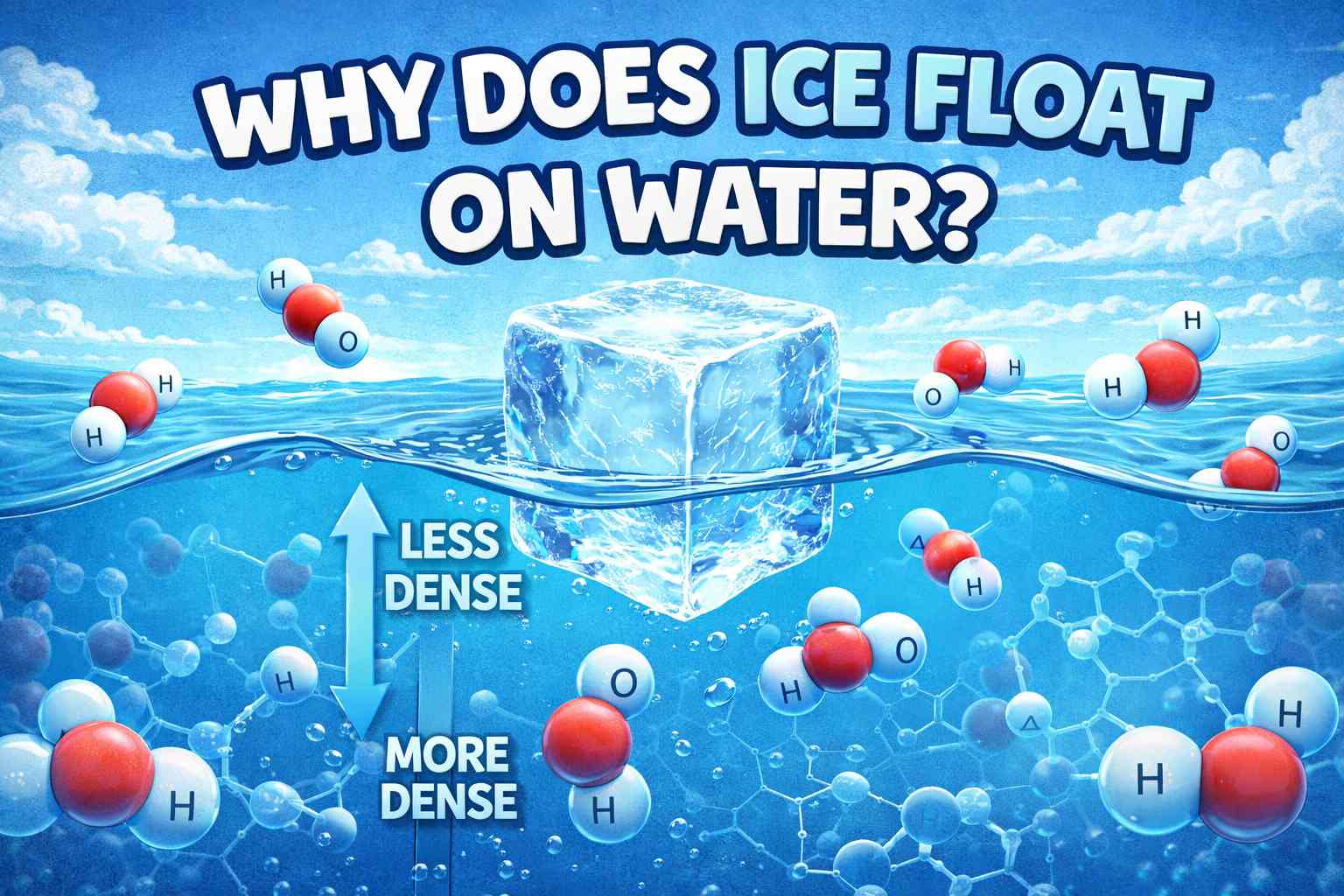
Water is made of tiny particles called molecules.
Each molecule is called H₂O, which means:
- 2 Hydrogen atoms
- 1 Oxygen atom
These molecules are always moving around!
🌡️ What Happens When Water Freezes?
When water is liquid, its molecules are:
- Moving freely
- Packed close together
But when water freezes into ice:
- Molecules slow down ❄️
- They arrange into a crystal pattern (like a hexagon!)
- They spread out more
🧊 The Big Secret: Density!
Now comes the key idea: density.
👉 Density means how tightly packed something is.
- Liquid water = molecules close together = more dense
- Ice = molecules spread out = less dense
Because ice is less dense, it floats on water!
🌊 Why Is This So Important?
Ice floating is not just cool—it’s super important for life on Earth!
🌍 Here’s why:
- Lakes and oceans freeze from the top, not the bottom
- The ice layer acts like a blanket, keeping water below warmer
- Fish and other animals can survive underneath 🐟
If ice sank, entire lakes could freeze solid—life would struggle to survive!
🧊 What About Icebergs?
Icebergs float in the ocean too!
But here’s something amazing:
👉 Only about 10% of an iceberg is above water
👉 The other 90% is hidden below!
That’s because ice is only slightly less dense than water.
🌟 DO YOU KNOW?
- Water is one of the few substances that expands when it freezes!
- Ice is about 9% less dense than liquid water.
- Frozen pipes burst in winter because water expands when it turns to ice! 🧊💥
🤯 FUN SCIENCE FACTS!
✨ The hexagon shape of ice crystals is why snowflakes have 6 sides ❄️
✨ If ice didn’t float, Earth’s climate would be very different!
✨ Scientists study ice to understand climate change and glaciers.
🎯 QUIZ TIME! (Test Your Ice IQ)
1️⃣ Why does ice float?
a) It is heavier
b) It is less dense
c) It is warmer
Answer: b
2️⃣ What happens to water molecules when frozen?
a) They move faster
b) They disappear
c) They spread out
Answer: c
3️⃣ What percentage of an iceberg is underwater?
a) 10%
b) 50%
c) 90%
Answer: c
🧪 TRY THIS AT HOME!
Ice vs Water Experiment
You need:
- A glass of water
- Ice cubes
Steps:
- Drop ice into the glass
- Watch how it floats
- Observe how much stays above water
Now you’ve seen density in action! 🔬
🌈 Encouragement to Explore
Next time you sip a cold drink, look at the floating ice and remember:
you’re seeing a special property of water that helps life survive on Earth!
Ask yourself:
- What other things float or sink?
- Does salt water change how ice floats?
Keep exploring—because even simple things like ice hold amazing scientific secrets! 🌍✨
Polar Bears in Danger: How Melting Ice is Changing Their Future ❄️🐻❄️