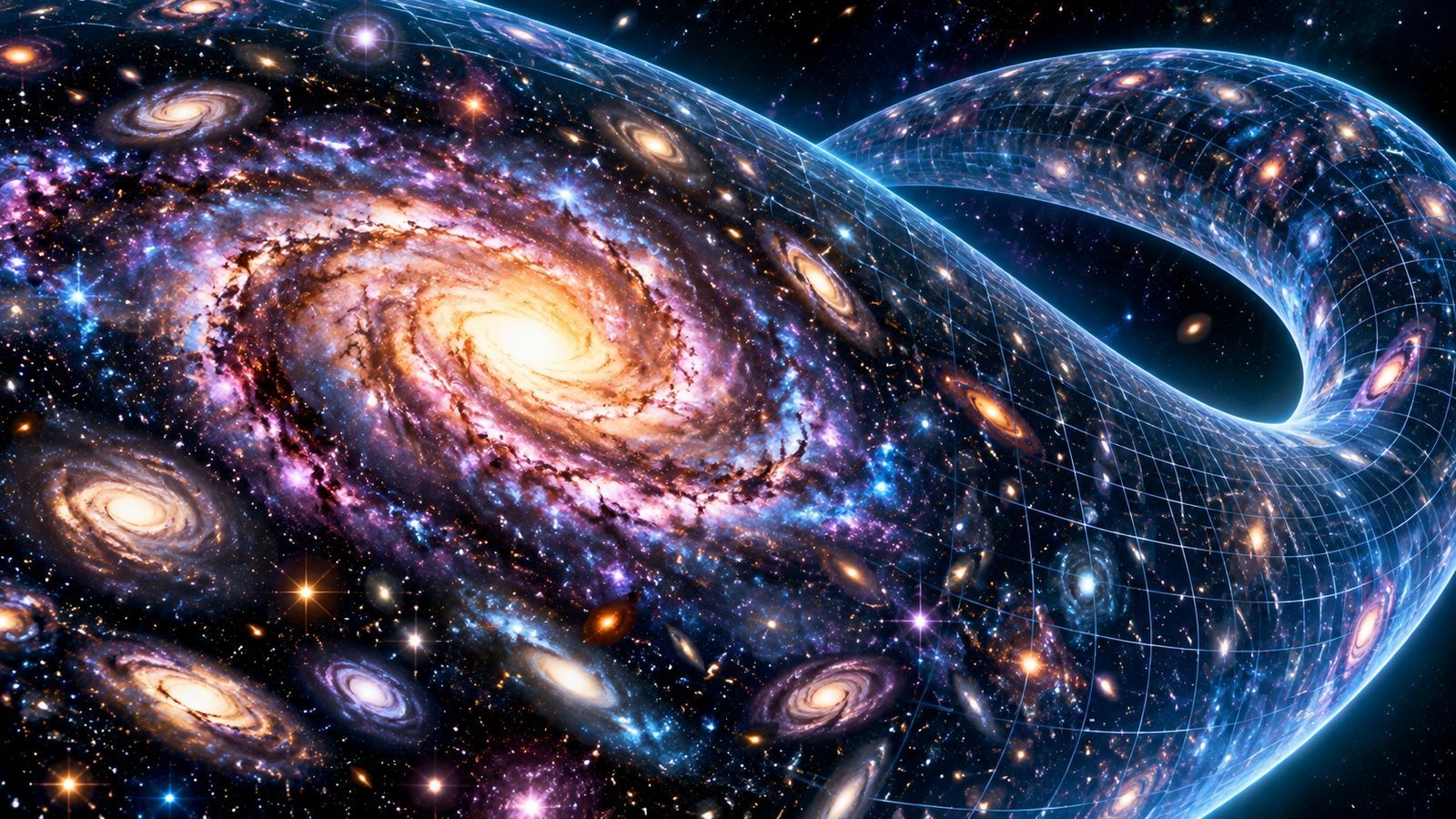
What If You Could Travel Forever Through Space?
Scientists have a surprising clue about the shape of the universe—but the biggest cosmic question is still unanswered.
📰 News in a Nutshell
Have you ever wondered what would happen if you kept flying through space without ever stopping? Would you eventually reach the end, go around in a giant cosmic circle, or simply keep going forever? Scientists have found that the universe looks extremely flat, but that does not prove it is infinite. The answer may be much stranger than any map of space we have ever seen.
Okay, space detectives, here is a HUGE question for you: if you climbed into the fastest spaceship imaginable and kept flying in one direction, would you ever reach the end of the universe? Maybe you would keep going forever. Maybe you would somehow come back to Earth from the other side. Or maybe the universe is shaped in a way our brains are simply not used to imagining!
First, Let's Talk About What We Can See
When astronomers look into space, they cannot see the entire universe. We live inside what scientists call the observable universe. That means the part of the cosmos from which light and information have had time to reach us.
Think about standing outside at night with a powerful flashlight. You can see only as far as the light reaches. Space is different because we are looking at light that has been traveling for billions of years. Beyond our cosmic horizon, there may be much, much more that we simply cannot observe.
Does the Universe Have an Edge?
Here is where things get wonderfully weird. You might imagine that a finite universe must have an edge, like a giant box. But scientists do not necessarily think that way.
Take Earth. Our planet's surface has a limited size, but if you walked in one direction around Earth, you would not fall off an edge. You could eventually come back to where you started.
Earth's surface is curved. Scientists can even detect that curve using geometry. For example, enormous triangles drawn across Earth's surface do not behave exactly like triangles on a flat sheet of paper.
So, Is Space Curved?
Astronomers have a clever way to investigate this. They study the cosmic microwave background, or CMB. Think of the CMB as a faint baby picture of the universe. It is ancient light released when the universe was only about 380,000 years old.
The CMB contains tiny patches with slightly different temperatures. Scientists know how large those patterns should appear if space is flat or strongly curved. When they compare their calculations with observations, the patterns look almost exactly the way they would in flat space.
That sounds like the mystery is solved, right? Not so fast!
Flat Space Does Not Mean Endless Space
Imagine you are measuring a tiny patch of Earth's surface. It might look completely flat because you are covering such a small area. You would need to travel much farther before Earth's curve became obvious.
The universe could work in a similar way. Our observable universe is unbelievably enormous, but the entire universe could be vastly bigger. If its overall curve is too huge for us to measure, space could look flat from our cosmic neighborhood even if it is curved on a much larger scale.
Could You Come Back to Where You Started?
Now imagine something even stranger. Space might be flat in its local geometry but still wrap around itself. Picture a flat sheet of paper. If you could connect two opposite edges without changing the local rules of the paper, traveling in one direction could eventually bring you around to the other side.
This is where topology enters the story. Topology is the study of how spaces are connected. It asks questions such as: Does this space loop? Does it have connected edges? Could something travel far enough and return to its starting point?
Mathematicians have discovered several possible shapes for spaces that can remain locally flat while having surprising overall connections. So the universe does not have to be an ordinary flat sheet stretching endlessly like an infinite road.
Have Scientists Found a Cosmic Loop?
Scientists have searched for clues. If the universe wrapped around itself on a scale we could observe, we might notice repeated patterns in the CMB or perhaps see the same distant galaxy appearing in different parts of the sky.
So far, astronomers have not found convincing evidence that the universe loops around itself. But there is an important catch: if the loop is larger than the part of the universe we can observe, we might never be able to detect it.
The Biggest Mystery Is Still Open
So, kids, here is the amazing part: scientists have excellent evidence that the observable universe is extremely close to geometrically flat, but that does not tell us with certainty whether the entire universe is infinite.
It could stretch forever. It could be enormously large but finite. It could even have a strange structure that connects distant parts of space together. And beyond all that, some cosmological ideas imagine that our universe could be one bubble among many.
For now, the universe is keeping its answer hidden. And honestly, that is one of the coolest things about science: sometimes the biggest discoveries begin with simply asking, “What if?”
✨ Did You Know?
📖 Science Word
TOPOLOGY
/tuh-POL-uh-jee/The study of how a space is connected, including whether it can loop or wrap around itself.
🔤 Word Scramble
Test Yourself!
Question 1 of 5
What is the observable universe?
Quick Poll
If you could travel anywhere in the universe, which mystery would you investigate first?
How fun was this cosmic mystery?