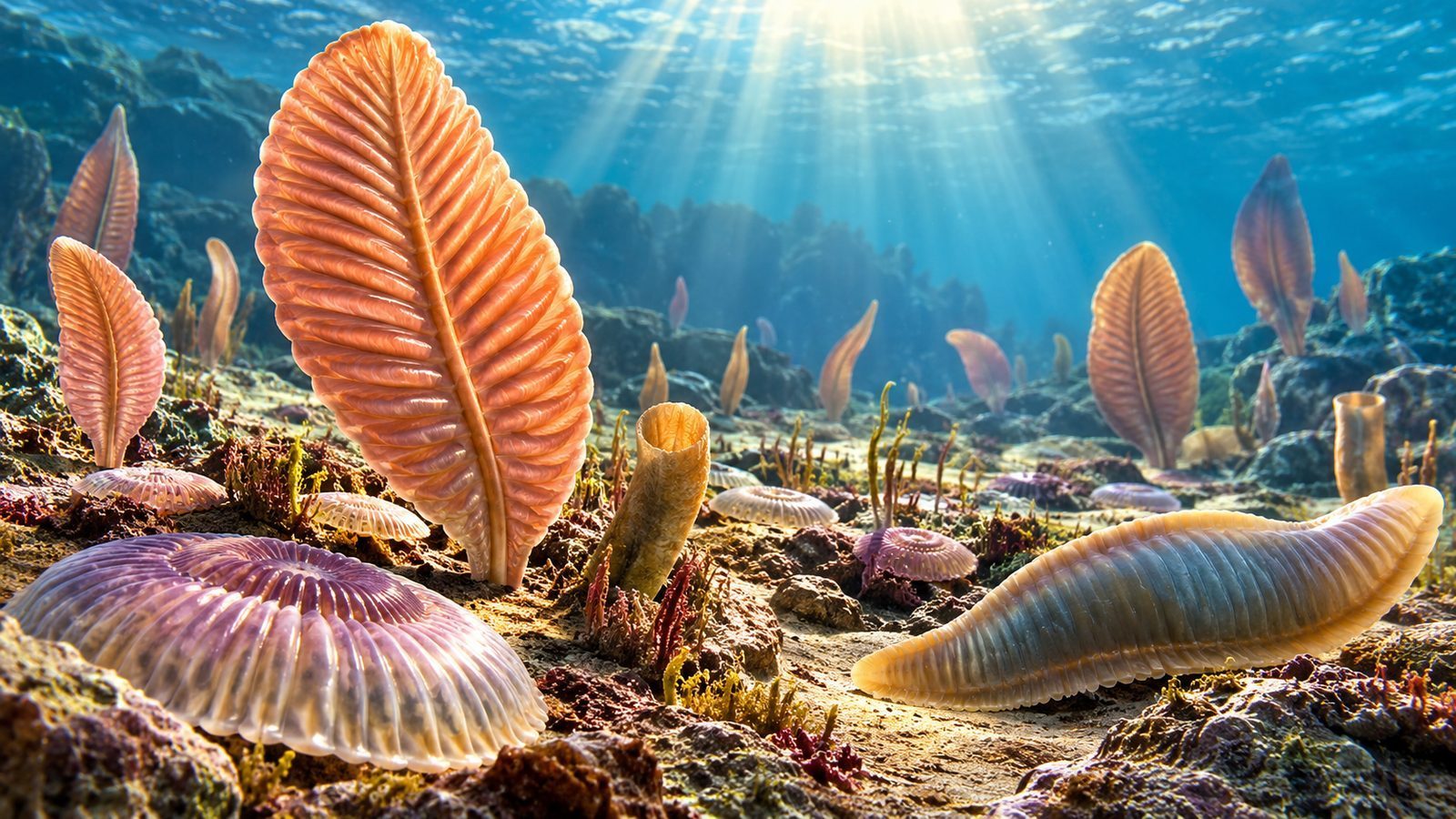
Were Animals Hiding in Earth's History for 200 Million Years?
A surprising fossil study suggests the animal kingdom's story may have started far earlier than its clearest fossils.
📰 News in a Nutshell
Scientists studying tiny ancient fossils have found evidence that challenges how we date the first animals, suggesting animal life could have begun between 800 and 700 million years ago.
Imagine opening a giant history book about Earth and discovering that its first 200 pages might be missing. Scientists think something similar may have happened with the history of animals.
A new study led by University of Oxford researchers suggests animals could have evolved up to 200 million years earlier than their clearest fossils would make us think.
Where Are the Missing Animals?
Fossils are remains or traces of ancient living things preserved in rock. Scientists often use them like clues at a gigantic prehistoric detective scene.
One famous fossil site in China, called the Weng'an Biota, is about 590 million years old. It contains amazingly detailed microscopic fossils, but scientists have not found anything there that can definitely be called an animal.
That once seemed like an important clue. If animals had existed, wouldn't such an excellent fossil site have preserved them?
Maybe not.
A Surprise Hidden in Mongolia
Researchers examined more than 140 samples from another fossil site, the Kheseen Biota in Mongolia. They used scanning electron microscopes, powerful instruments that can reveal incredibly tiny details.
The fossils were beautifully preserved. Scientists found strange microscopic organisms, including spiky forms and embryo-like fossils containing internal cells. Yet they still couldn't confidently identify an animal.
Here's the twist: scientists already know animals existed elsewhere on Earth when these Mongolian rocks formed.
So a fossil site can preserve tiny organisms extremely well and still somehow miss the animals living at the same time. It's like taking excellent photographs of a forest but never capturing a deer, even though deer definitely live nearby.
A Genetic Clock Runs Backward
The researchers then used a molecular clock. This technique compares genetic differences between living species and uses them to estimate when their ancient ancestors lived.
When scientists used much older fossil deposits as time limits for their calculations, the possible origin of animals shifted backward to roughly 800 to 700 million years ago.
There are other clues too. Ancient chemical traces called biomarkers may point to sponge-like animals living at least 650 million years ago.
Did Animals Survive Snowball Earth?
If animals really existed that early, they may have appeared before or during an astonishing chapter of Earth's history called Snowball Earth. Around 720 million years ago, enormous glaciers spread across much of the planet.
The first animals were probably tiny and soft-bodied. Without bones or shells, their bodies would have disappeared easily instead of becoming fossils.
Scientists aren't claiming they have proved animals existed 800 million years ago. Instead, the study shows that missing fossils don't necessarily mean missing animals. Researchers now need to search more ancient rocks around the world for the clues that could finally reveal when the animal kingdom truly began.
✨ Did You Know?
📖 Science Word
Biomarker
/BY-oh-mar-ker/A chemical clue left behind by living organisms that can sometimes survive in ancient rocks.
🔤 Word Scramble
Test Yourself!
Question 1 of 5
How much earlier might animals have evolved than some fossil evidence suggested?
Quick Poll
Where do you think scientists are most likely to find the next big clue about Earth's first animals?
How fun was this article?