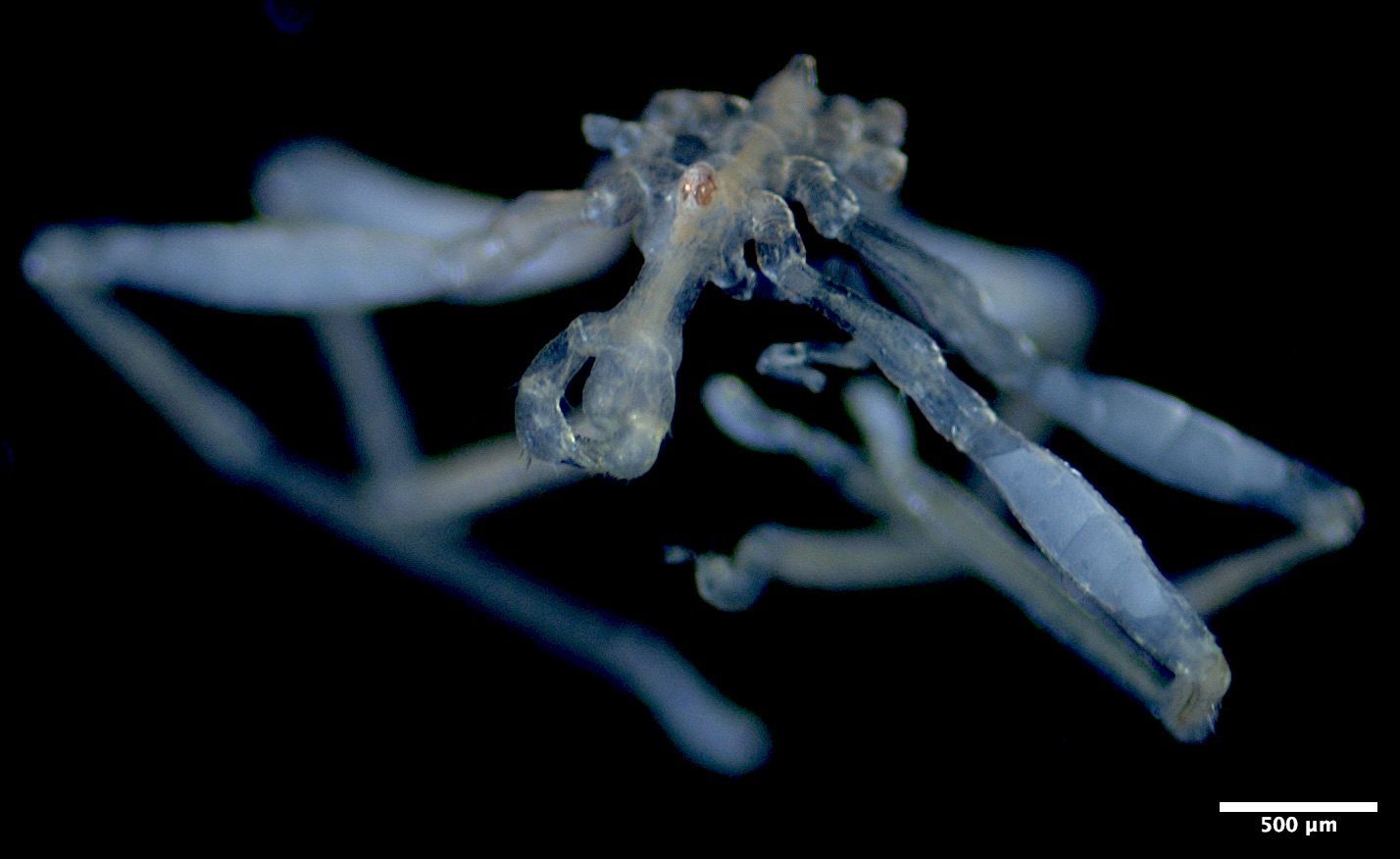
Two Bizarre Sea Spiders Just Revealed Their Creepy Secrets
One has hairy legs and red eyes, while the other can carry tiny parasites of its own.
📰 News in a Nutshell
Scientists at the University of British Columbia have discovered two new species of sea spider in the Salish Sea. One has hairy-looking legs, red eyes and a strange mouth, while the other is often covered in tiny parasites. The discoveries show that there may still be many unknown marine animals hiding in this coastal ecosystem.
Imagine diving into the ocean and discovering an animal that looks like a tiny alien spider, has red eyes, hairy legs and a mouth surrounded by strange tendrils. Scientists exploring the Salish Sea have now described two sea spider species that were previously unknown to science.
Ancient Animals With Strange Tricks
Sea spiders are marine arthropods, a group of animals with jointed legs and hard outer bodies that includes insects, crabs and spiders. They have been around for roughly 500 million years. Some species have up to 12 legs, and they use a tube-like mouthpart called a proboscis to suck food from their prey or hosts.
Sea spiders have some surprising biology. They breathe through their skin, and males carry and care for the developing eggs. Their egg-carrying limbs are called ovigers.
The Hairy-Legged Mystery
The first new species was named Callipallene pilosuspedes, a name inspired by Latin words meaning “hairy feet.” It has long curved spines along parts of its legs, bright-looking red eyes and a short proboscis with claws for grabbing food.
Its mouth is especially unusual. It has three lips surrounded by sensory tendrils, which help the animal detect its surroundings. Scientists also discovered that its ovigers can act like tiny cleaning tools. Under a microscope, they watched the sea spider wrap these limbs around its legs and use comb-like spines to groom itself.
Only one specimen of this species was found, making the discovery even more intriguing.
A Sea Spider With Tiny Passengers
The second species, Tanystylum kiixin, has smaller egg-carrying limbs and appears to be less able to clean itself. Researchers often found dirt and debris attached to its body, along with tiny parasites.
A parasite is an organism that lives on or inside another organism and gets resources from it. Scientists described the situation as an “ecosystem within an ecosystem” because the sea spider itself can support even smaller life-forms.
What Is Still Hiding Below?
The researchers collected specimens during dives as deep as 18 metres around parts of British Columbia. They combined detailed microscope images with DNA analysis, which examines genetic information to help scientists identify and compare species.
The study is the first comprehensive investigation of Salish Sea sea spiders to combine these approaches. The scientists also created an identification guide and found evidence that more sea spider diversity may still be waiting to be discovered.
✨ Did You Know?
📖 Science Word
PROBOSCIS
/proh-BOSS-is/A long, tube-like mouthpart that some animals use to suck up food.
🔤 Word Scramble
Test Yourself!
Question 1 of 5
Where were the two new sea spider species discovered?
Quick Poll
Which sea spider feature would you most want to see under a microscope?
How fun was this article?