Meet the Mysterious Golden Tree of the Deep Sea!
Scientists discovered a spectacular yellow coral unlike any known family, hidden hundreds of meters beneath the Pacific Ocean.
📰 News in a Nutshell
Scientists exploring deep underwater mountains near Costa Rica discovered a bright yellow, tree-shaped coral surrounded by star-like sea creatures. When they studied its DNA, they found something astonishing: it was so different from known corals that it needed an entirely new scientific family!
Imagine diving hundreds of meters beneath the ocean, where sunlight barely reaches, and discovering what looks like a golden tree growing from the rocky seafloor.
Now imagine that tree surrounded by hundreds of tiny, star-shaped creatures. It sounds like a scene from a fantasy movie, doesn't it?
But this extraordinary underwater world is real! Scientists exploring the Pacific Ocean near Costa Rica have discovered a spectacular yellow coral so unusual that it has earned its very own scientific family.
A Golden Tree in the Deep Ocean
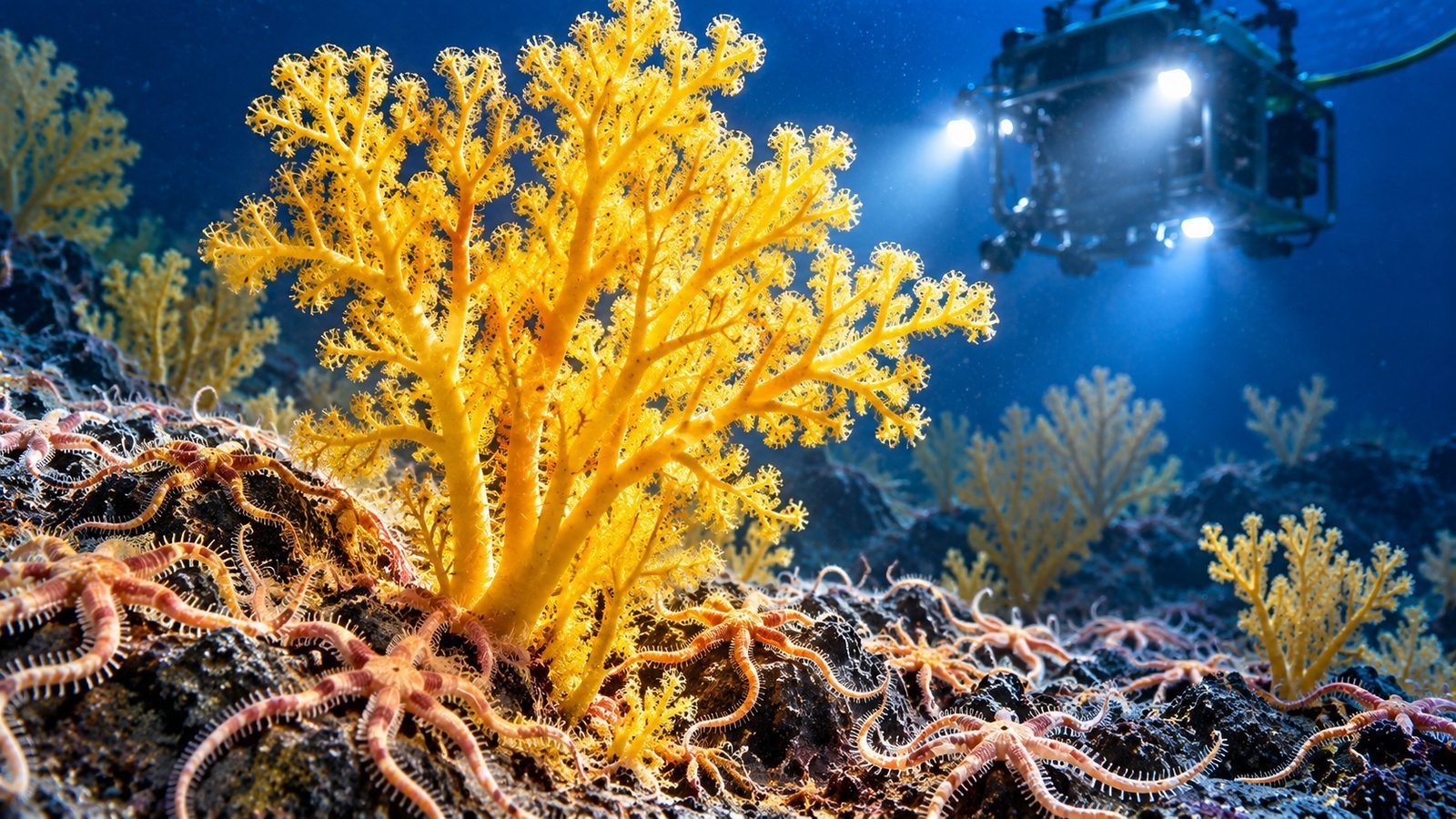
The newly discovered coral grows between 360 and 529 meters beneath the ocean surface. Some colonies reach more than one meter tall!
Unlike the colorful coral reefs we often see in tropical photographs, this creature lives in deep, dark water.
Its brilliant yellow branches resemble a miniature golden tree rising from the ocean floor.
And the scenery around it is just as amazing.
The rocky seabed is covered with brittle stars, sea animals related to starfish that have long, slender, flexible arms.
Picture a golden tree growing in a garden filled with living stars!
A Name Straight Out of a Fantasy Story
The scientists named their discovery Laurinque elenya.
That unusual name was inspired by Quenya, an imaginary Elvish language invented by author J.R.R. Tolkien for his fantasy world.
Laurinque comes from a word meaning golden tree, while elenya means stellar or of the stars.
Put them together and you get a beautiful description: golden tree of the stars!
It's a wonderful example of how science, imagination, and literature can meet.
The DNA Mystery That Surprised Scientists
At first, researchers thought the coral might belong to a family scientists already knew.
In biology, a family is a group of related organisms that share important characteristics.
But when the team examined three different genes, the results were confusing. Each gene suggested a different coral family!
So the researchers tried something more powerful called phylogenomics, a technique that compares hundreds of genes to investigate how organisms are related.
Think of it like solving a family-tree puzzle. Instead of checking just three clues, scientists examined hundreds!
The answer was remarkable.
This coral represented a previously unknown evolutionary branch. Its genetic and physical differences were so important that scientists created a brand-new family called Laurinqueidae.
How Did Scientists Reach This Hidden World?
Researchers explored the deep ocean during expeditions in 2019 and 2023 aboard the research ships Falkor and Falkor (too).
They used SuBastian, a remotely operated underwater vehicle, or ROV. An ROV is a robot controlled from a ship that can explore places too deep or difficult for human divers.
The robot helped scientists collect coral specimens from underwater mountains called seamounts.
Why This Discovery Matters
Deep-sea coral gardens are much more than beautiful underwater scenery.
Their branches provide places where other marine animals can live, hide, and find food. These habitats support biodiversity, meaning the variety of living things in an environment.
Unfortunately, deep-sea coral gardens can also be vulnerable to damage.
Discovering an entirely new coral family reminds us how much of Earth's oceans remains unexplored.
And perhaps the most exciting question is still waiting for an answer: What other extraordinary creatures are hiding in the deep sea?
✨ Did You Know?
📖 Science Word
Phylogenomics
/FY-loh-juh-NOH-miks/A scientific method that compares many genes from different organisms to discover how they are related through evolution.
🔤 Word Scramble
Test Yourself!
Question 1 of 5
Where was the unusual golden tree coral discovered?
Quick Poll
If you could explore the deep ocean in a robot submarine, what would you most want to discover?
How fun was this article?