Curiosity Has Spent 5,000 Days on Mars—and Look at the View!
NASA's long-running Mars rover marked an incredible milestone with a spectacular postcard from the Red Planet.
📰 News in a Nutshell
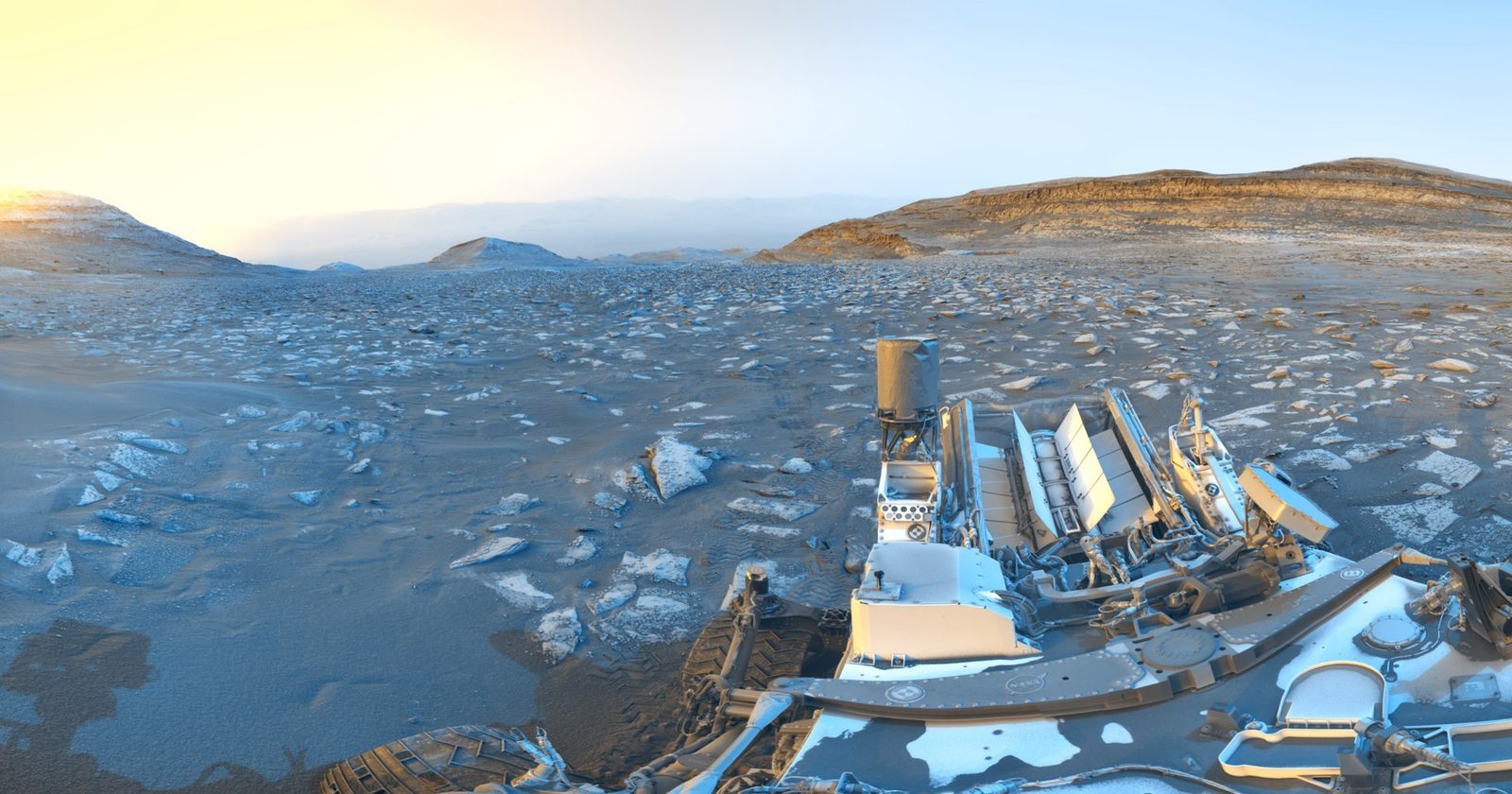
NASA's Curiosity rover has now spent 5,000 Martian days exploring Mars. To celebrate, the rover photographed its surroundings at different times of day, and scientists combined the images into one spectacular Mars postcard. The view shows Curiosity, its tracks and the huge landscape around Mount Sharp inside Gale Crater.
Hey, Mars explorers! Imagine waking up every morning, looking around, and realizing that you are on another planet. Now imagine doing that not for a few days, but for 5,000 Martian days! That's exactly what NASA's Curiosity rover has been doing.
Curiosity has reached an amazing milestone on Mars, and it celebrated in a very Curiosity-like way: by taking pictures. The rover sent home a spectacular view of the Red Planet that looks almost like a giant space postcard.
5,000 Days on Another Planet!
Curiosity landed on Mars in 2012. Since then, this six-wheeled robotic explorer has been rolling across the Martian landscape, studying rocks, soil and the planet's ancient history.
On Mars, a day is called a sol. A sol is slightly longer than an Earth day—about 24 hours and 39 minutes. So Curiosity's 5,000 Martian days add up to even more than 5,000 Earth days.
That's a very long road trip when your destination is another planet!
A Rover's Very Special Postcard
For its 5,000th sol, Curiosity was parked near a sandy ridge nicknamed Chocolatal. The rover used its navigation cameras to photograph the landscape.
But here's the clever part: Curiosity took one panorama in the morning and another in the afternoon. Scientists then combined the two views into one giant scene.
The original navigation-camera pictures were black and white. For the finished postcard, color was added as an artistic interpretation. Blue represents the morning view, while yellow represents the afternoon view.
So when you look at the image, you're really seeing different moments of a Martian day blended together!
Can You Spot Curiosity?
Look carefully at the foreground of the picture. You can actually see parts of the rover itself.
One visible part is Curiosity's UHF antenna. UHF stands for ultra-high frequency, and this antenna helps Curiosity send data to spacecraft orbiting Mars. Those orbiters can then relay information back toward Earth.
You can also see part of the rover's MMRTG, its power source. The MMRTG uses heat produced by radioactive material to generate electricity, helping Curiosity keep working even when sunlight is weak or dust gets in the way.
And don't miss the tracks! Curiosity's wheel marks stretch across the Martian ground, showing where this robotic explorer has traveled.
Look at That Giant Mountain!
Curiosity is exploring the lower foothills of Mount Sharp, a huge mountain rising about 5 kilometers—around 3 miles—inside Gale Crater.
Gale Crater is an enormous impact crater, created long ago when something crashed into Mars. Curiosity has been climbing and investigating the mountain because its layers of rock contain clues about how Mars changed over time.
From Curiosity's position, the new panorama looks downhill toward the crater floor. The distant rim of Gale Crater can be seen faintly along the horizon.
Why Does This Milestone Matter?
Five thousand sols isn't just a big birthday number. Every day Curiosity survives and explores gives scientists another chance to learn about Mars.
The rover studies rocks, minerals, dust and the landscape to understand what Mars was like billions of years ago. Scientists are especially interested in whether ancient Mars once had environments that could have supported microbial life.
And after 5,000 Martian days, Curiosity is still exploring.
Your Turn, Space Explorer!
Think about the picture again. Those tracks in the dirt are more than wheel marks. They are a record of a journey across another world.
Curiosity has traveled across Mars for years, sending photographs and scientific measurements across millions of kilometers of space to Earth.
So here's a fun question: If NASA gave you control of Curiosity for one day, what would you ask it to explore?
A strange rock? A mountain slope? A dusty valley? Or perhaps a place where nobody has ever looked closely before?
For now, Curiosity keeps rolling—and Mars keeps revealing its secrets one sol at a time.
✨ Did You Know?
📖 Science Word
SOL
/SAHL/A Martian day, which lasts about 24 hours and 39 minutes on Earth.
🔤 Word Scramble
Test Yourself!
Question 1 of 5
What is a day on Mars called?
Quick Poll
If you could choose Curiosity's next Mars adventure, what would you pick?
How fun was this Mars adventure?