CosmoCube: The Tiny Spacecraft Listening for the Universe Before the First Stars
A suitcase-sized spacecraft could hide behind the Moon and listen for an ancient radio whisper from the universe's mysterious dark ages.
📰 News in a Nutshell
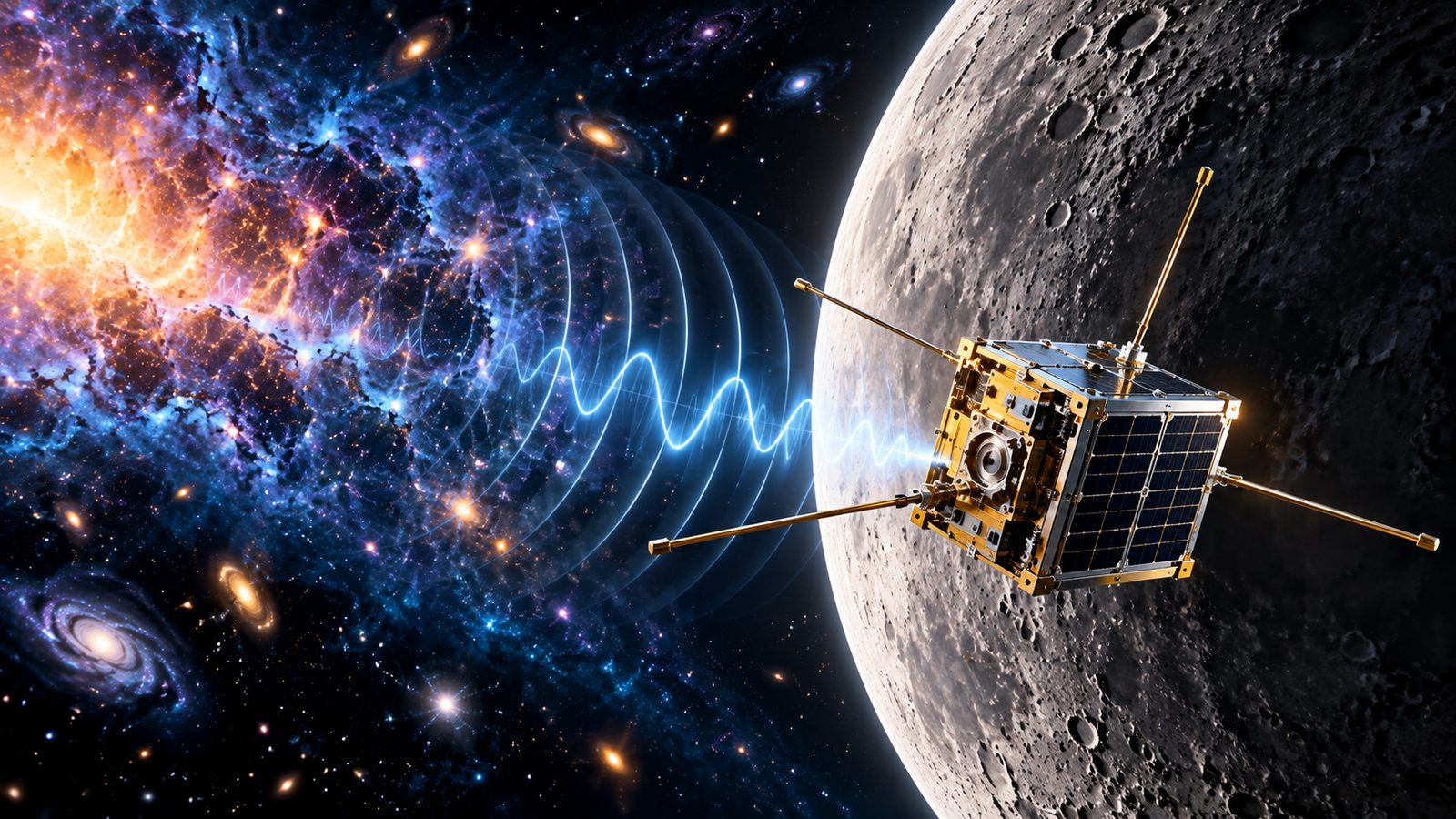
Imagine trying to hear a tiny whisper from more than 13 billion years ago. Scientists are getting ready to try with CosmoCube, a small spacecraft designed to orbit the Moon and search for an ancient radio signal from the time before the universe's first stars appeared. The Moon could act as a giant shield, helping CosmoCube escape radio noise from Earth and investigate one of the biggest mysteries in space science.
Hey, space explorers! Imagine trying to hear a tiny whisper from more than 13 billion years ago. Sounds impossible, right? Scientists are getting ready to try. Their secret listener is called CosmoCube, a small spacecraft that could travel around the Moon to search for clues from a time before the first stars ever shone.
The mission is aimed at the Cosmic Dark Ages, a mysterious period when the young universe had cooled down but stars had not yet appeared. There were no glowing galaxies lighting up the sky. Instead, space was filled largely with hydrogen gas.
A Hidden Message From Baby Space
So how can scientists investigate something that happened billions of years ago? They can look for an ancient radio signal made by hydrogen.
This signal is called the 21-centimeter line. It is a particular radio wavelength produced by hydrogen atoms. If CosmoCube can detect it, scientists could learn what the universe was doing before the first stars switched on.
That could help answer a gigantic question: How did the dark, simple young universe become the star-filled cosmos we see today?
Earth Is Way Too Noisy
Here is the tricky part. Our planet is not a quiet place for radio astronomy. Radio stations, satellites, communication systems and other technology create radio signals that can drown out extremely faint signals from space.
Earth's ionosphere also blocks many of the low-frequency radio waves scientists need for this investigation.
Trying to find the ancient hydrogen signal from Earth would be like trying to hear one tiny whisper while thousands of people are shouting around you.
The Moon Has a Clever Trick
This is where CosmoCube gets clever.
The spacecraft is designed to orbit the Moon. When it moves behind the Moon, the Moon itself blocks radio interference coming from Earth. The lunar far side becomes a giant natural shield.
For about 40 minutes during each roughly two-hour orbit, CosmoCube could pass through this radio-quiet zone. Over an expected two-year mission, scientists hope to collect about 1,000 hours of observations.
Imagine the Moon becoming a giant cosmic umbrella that protects a tiny spacecraft from Earth's radio rain!
A Suitcase-Sized Space Detective
CosmoCube may be small—roughly the size of a small carry-on suitcase—but its job is enormous.
It will carry a sensitive instrument called a radiometer. A radiometer measures electromagnetic radiation, including radio waves. CosmoCube will also use a lightweight antenna to listen across the sky.
But there is another problem: the spacecraft itself can make tiny amounts of electronic noise. Scientists have designed special calibration equipment to help separate this spacecraft noise from the incredibly faint signal they are hunting.
What Could CosmoCube Tell Us?
If scientists detect the ancient hydrogen signal, they could learn much more about the Cosmic Dark Ages and the moment when the first stars began to appear.
The mission could also teach scientists about dark matter. We cannot see dark matter directly, but its gravity helps shape the large structures of the universe. Researchers want to understand how dark matter helped pull ordinary hydrogen together and set the stage for the first stars and galaxies.
A Tiny Mission With a Giant Question
And this is perhaps the coolest part. Scientists do not always need a giant telescope the size of a building to ask giant questions.
CosmoCube is a compact spacecraft designed to use one of the quietest radio environments near Earth: the far side of the Moon.
If the mission succeeds, it could open a new window onto a time we have never directly observed.
So, the next time you look at the Moon, imagine a tiny spacecraft hiding behind it, listening very carefully.
What might it hear?
Perhaps a whisper from the universe's first chapter.
✨ Did You Know?
📖 Science Word
RADIOMETER
/ray-dee-OM-uh-ter/An instrument that measures electromagnetic radiation such as radio waves.
🔤 Word Scramble
Test Yourself!
Question 1 of 5
What is CosmoCube designed to investigate?
Quick Poll
If you could ask CosmoCube one question about the early universe, what would you choose?
How fun was this cosmic adventure?