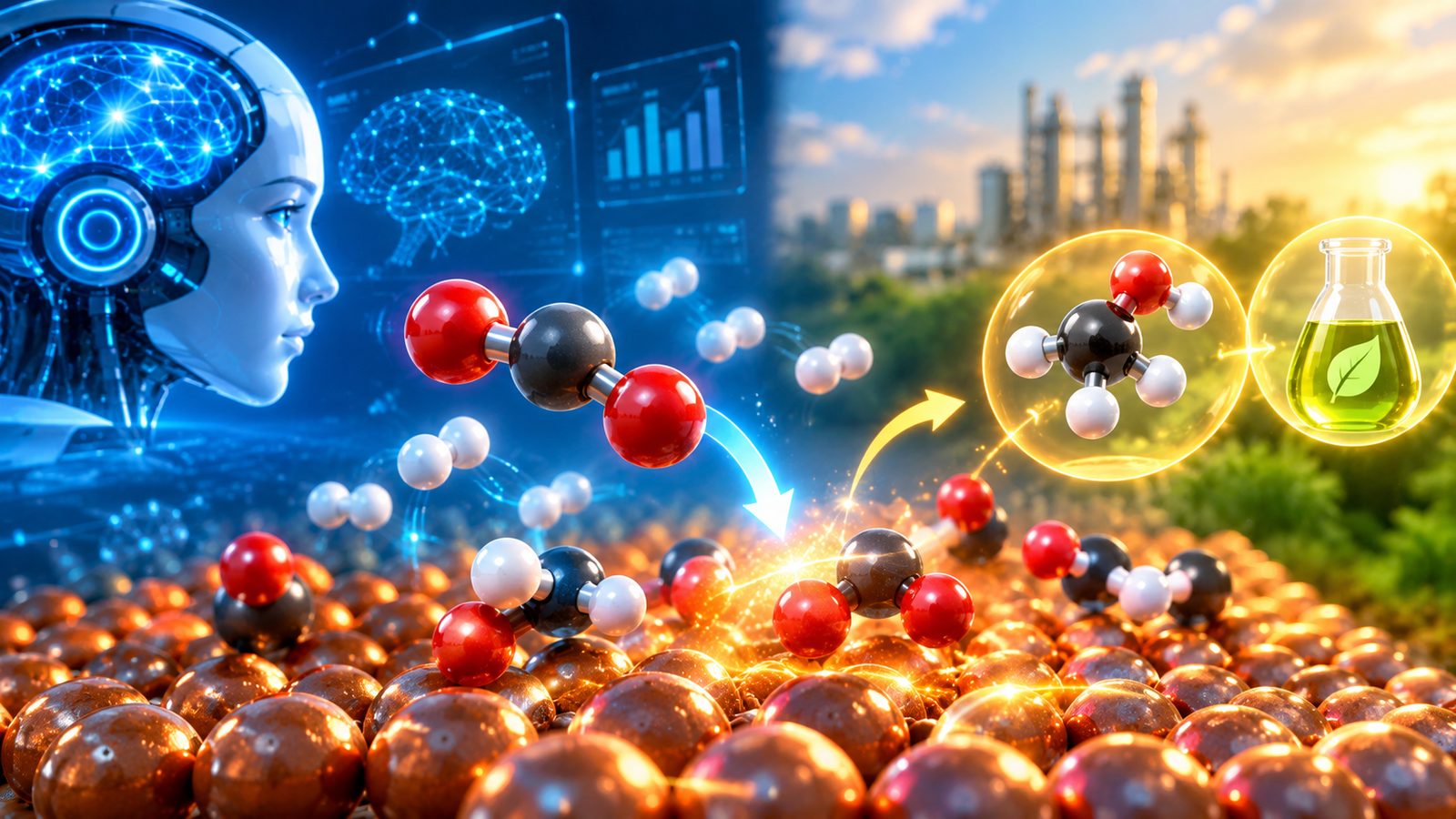
Can AI Help Turn CO2 Into Fuel?
Scientists uncovered 9,389 chemical reactions and a surprising hydrogen shortcut that could help improve carbon recycling.
📰 News in a Nutshell
What if artificial intelligence could help scientists turn carbon dioxide into useful chemicals? Researchers at the Indian Institute of Science used AI-powered machine learning and computer simulations to identify 9,389 possible reactions on a copper catalyst. Their expanded model predicted carbon dioxide conversion about 40 times higher than their original model and revealed an unexpected way hydrogen can take part in the process. The findings could help scientists design better catalysts in the future.
Hey, science explorers! You probably know carbon dioxide, or CO2, as a gas we breathe out and plants use to grow. But did you know scientists are also investigating ways to turn this gas into useful products, including fuels and industrial chemicals? Now, artificial intelligence has helped researchers uncover thousands of hidden steps that could make this process easier to understand.
The team at the Indian Institute of Science (IISc) in India identified 9,389 individual chemical reactions that can occur on a copper catalyst during a process used to transform CO2 into chemicals such as methanol. Their findings, published in Nature Communications, reveal why looking at more of the chemistry can make a huge difference.
Why Is Turning CO2 Into Chemicals So Tricky?
One promising technique is called hydrogenation. In simple terms, it involves reacting a substance with hydrogen. In this case, scientists study how carbon dioxide can react with hydrogen to form products such as methanol, a chemical used as an industrial ingredient and fuel.
A catalyst helps a chemical reaction happen by providing a more favorable route. Copper can act as a catalyst in this process, but its surface can host many different chemical species and reaction steps. Imagine a giant maze with thousands of possible turns. If you study only a few routes, you might miss the path that leads to the right destination!
Scientists can use quantum mechanics calculations to investigate chemical reactions, but examining every possible step can require enormous computing power. As a result, researchers often begin with a smaller selection of reactions. The danger is that an important step might be left out.
How AI Helped Find the Missing Steps
The research team first used detailed computer simulations based on quantum mechanics to build a database of 152 reactions. They then trained machine learning models—a type of AI that learns patterns from data—to estimate how much energy other possible reactions would need.
Using automated computer tools, the researchers examined 105 chemical species on the catalyst surface and explored which transformations could happen in a single step. Their reaction network grew from 152 reactions to an astonishing 9,389.
And the extra detail mattered! The smaller model predicted that formic acid would be the main product instead of methanol. It also underestimated how much CO2 could be converted. With the much larger reaction network, the model's predictions lined up better with experimental results.
A 40-Times Difference—and a Hydrogen Surprise
When researchers used the expanded network to model how quickly the reactions could occur, the predicted amount of CO2 conversion increased by about 40 times compared with the original model. The improved model also correctly identified methanol and carbon monoxide as major products.
That number describes the difference between two computer models. It does not mean a factory has already started converting CO2 into fuel 40 times more efficiently. The research provides a more complete way to predict the chemistry and guide future experiments.
The team also uncovered a surprising possible route for hydrogen. In certain reaction steps, hydrogen could be transferred to intermediate chemicals as an intact H2 molecule, rather than only after being split into separate hydrogen atoms. Further quantum mechanics calculations supported the possibility of this pathway, particularly for some intermediates containing oxygen.
Think of hydrogen as a pair of teammates. Scientists often expected the pair to separate before taking part in certain steps, but the calculations revealed that the two could sometimes move together. This insight might help researchers explore catalysts that interact more effectively with hydrogen.
Could This Help the Planet?
Finding better ways to use CO2 could eventually help researchers develop processes for recycling carbon into useful products. However, converting CO2 requires energy and carefully designed chemical systems, so this discovery alone does not solve climate change or make every fuel carbon-neutral.
The research method could also help scientists study other complicated chemical processes, including nitrogen reduction and water splitting. By combining AI, computer simulations, and experimental checks, researchers can investigate possibilities that simpler models might overlook.
So here's the big question: What other hidden chemical routes might scientists discover when AI helps them explore a much bigger maze of reactions? This time, thousands of missing steps revealed a surprising clue—and scientists now have a better map for their next experiments!
✨ Did You Know?
📖 Science Word
CATALYST
/KAT-uh-list/A substance that helps a chemical reaction happen more easily without being used up overall in the reaction.
🔤 Word Scramble
Test Yourself!
Question 1 of 5
How many individual reactions did the expanded network identify?
Quick Poll
If scientists could improve one technology using AI, which would you choose?
How fascinating was this discovery about AI, chemistry, and turning CO2 into useful products?