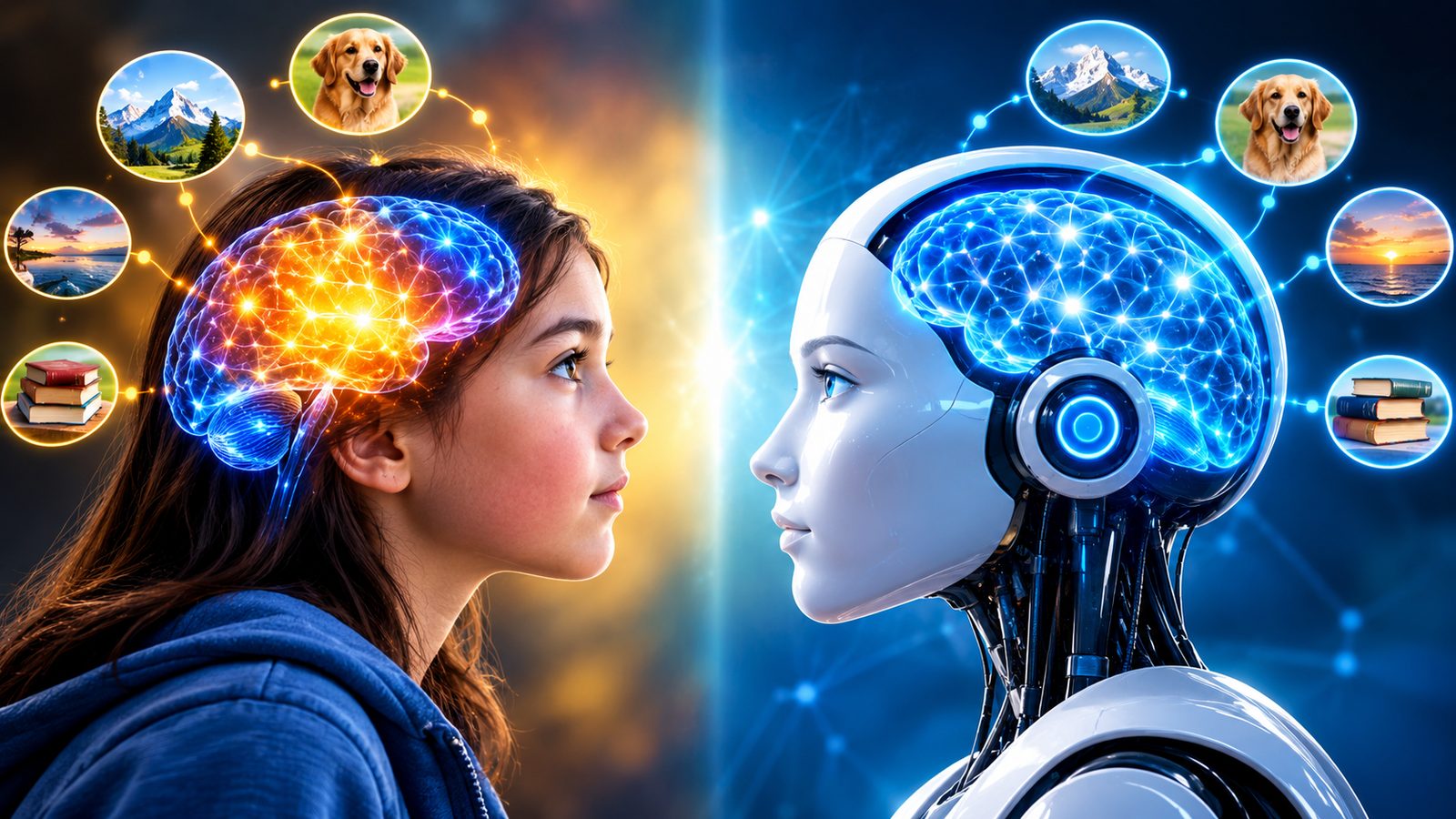
Can AI Really Be Conscious?
Scientists discovered that people judge human minds and artificial intelligence differently—even when they behave in exactly the same way.
📰 News in a Nutshell
Imagine a robot that talks, reacts, and recognizes emotions just like a person. Would you think it was conscious? In a study involving nearly 1,100 people, researchers found that people were much less likely to call AI conscious than humans, even when both behaved identically. But when researchers used the word awareness instead, the difference became much smaller.
Hey, future scientists! Imagine meeting a robot that can answer your questions, notice when you sound upset, and react to things happening around it. It might seem so human that you start wondering: Does it actually have a mind of its own?
That is the big question behind a new study from Ludwig Maximilian University of Munich in Germany. Researchers wanted to discover whether people judge artificial intelligence, or AI, the same way they judge humans when both behave in exactly the same way. Their results revealed something surprising: the words we use can change how we think about a machine's mind.
How Did Scientists Test People's Opinions?
The research team, led by Dr. Louis Longin and working with other scientists, conducted experiments involving nearly 1,100 participants. Their findings were published in the scientific journal Cognition.
Participants read short descriptions of characters responding to their surroundings. Some characters reacted to sounds, while others recognized how people were feeling. The researchers varied how responsive these characters were.
One group was told the characters were AI systems. Another group read the same situations, but the characters were described as humans. Participants then rated how conscious or aware each character seemed to be.
Keeping the behavior the same helped researchers compare people's judgments without changing what the characters actually did.
The Surprising Difference Between AI and Humans
First, the researchers noticed that responsiveness mattered. Characters that reacted more actively to their surroundings were generally judged as more conscious and more aware.
But here is the twist! When participants were asked about consciousness, they still gave humans higher ratings than AI. Even the most responsive AI character was rated as less conscious than the least responsive human character. Acting like a person did not automatically make a machine seem to have a human-like mind.
Now for the really interesting part: the pattern changed when participants were asked about awareness. Their judgments of humans and AI became much more similar.
Awareness and Consciousness: Are They the Same?
These two words sound alike, but they can suggest different things. Awareness can mean noticing information and responding to what is happening. For example, a computer system might detect a sound or identify a face in an image.
Consciousness is a deeper and more difficult idea. It is connected to the question of whether there is an inner experience—what it is like to be something, rather than simply responding to information. Scientists and philosophers continue to debate how consciousness works and how it could be recognized.
Think of a motion-sensing light. It can detect movement and switch on, but that does not mean it feels surprised when someone walks past! Similarly, an AI system can recognize words about sadness without that ability proving that it actually feels sadness.
Why Does the Language We Use Matter?
AI can produce remarkably human-like conversations, so it is easy to say that it wants something, understands us, or has a plan. But these descriptions can make its abilities sound more human than the evidence supports.
The researchers say that words matter when we talk about AI. Saying that a system detects something describes an observable ability. Calling it conscious suggests something much bigger about its possible inner experience.
One important point: this study measured people's judgments. It did not prove that AI is or is not conscious. Instead, it showed that people distinguish between human and artificial minds, and that the wording of a question can influence those judgments.
Your Turn, AI Detective!
If a robot recognizes your voice, answers your questions, and notices when you look upset, what can you confidently say? You can say it performs those tasks. But whether it has an inner experience is a much harder question.
As AI becomes more capable, scientists will need careful experiments and clear language to explore what these systems can do—and what their behavior does not prove. So next time a chatbot sounds human, remember: sounding human and having a conscious experience are two different questions!
✨ Did You Know?
📖 Science Word
CONSCIOUSNESS
/KON-shus-ness/The state associated with having experiences and an inner point of view, rather than simply responding to information.
🔤 Word Scramble
Test Yourself!
Question 1 of 5
How many people took part in the study?
Quick Poll
If an AI talked and reacted just like a human, what would you want scientists to investigate first?
How fascinating was this mystery about AI and consciousness?