The Scientist Who Hunts Ghost Particles Beneath Antarctic Ice!
Explore how Francis Halzen helped scientists discover mysterious messengers from space using a giant detector beneath Antarctica.
📰 News in a Nutshell
Scientists have turned Antarctic ice into a gigantic particle detector! Francis Halzen helped develop the IceCube Neutrino Observatory, which searches for mysterious particles called neutrinos. These tiny cosmic messengers travel across the universe and can reveal clues about powerful events happening in distant galaxies.
Imagine standing on the frozen surface of Antarctica. Deep beneath your boots, thousands of scientific sensors are searching for something extraordinary. They are hunting invisible particles that can travel straight through our planet!
Sounds like science fiction? This is real science, and physicist Francis Halzen helped make it possible.

A Giant Scientific Mystery
Our universe is filled with tiny particles called neutrinos, pronounced new-TREE-nohz.
These particles have almost no mass and no electric charge. Scientists call them ghost particles because they rarely interact with ordinary matter.
In fact, trillions of neutrinos pass through your body every second without you noticing!
Imagine a tennis ball flying through an entire building without touching a single wall. Neutrinos are completely different from tennis balls, but this strange comparison helps explain their amazing ability to pass through material.
Why Build a Telescope Under Ice?
Francis Halzen and an international team developed an extraordinary idea: use the clear, ancient ice beneath Antarctica to detect these nearly invisible particles.
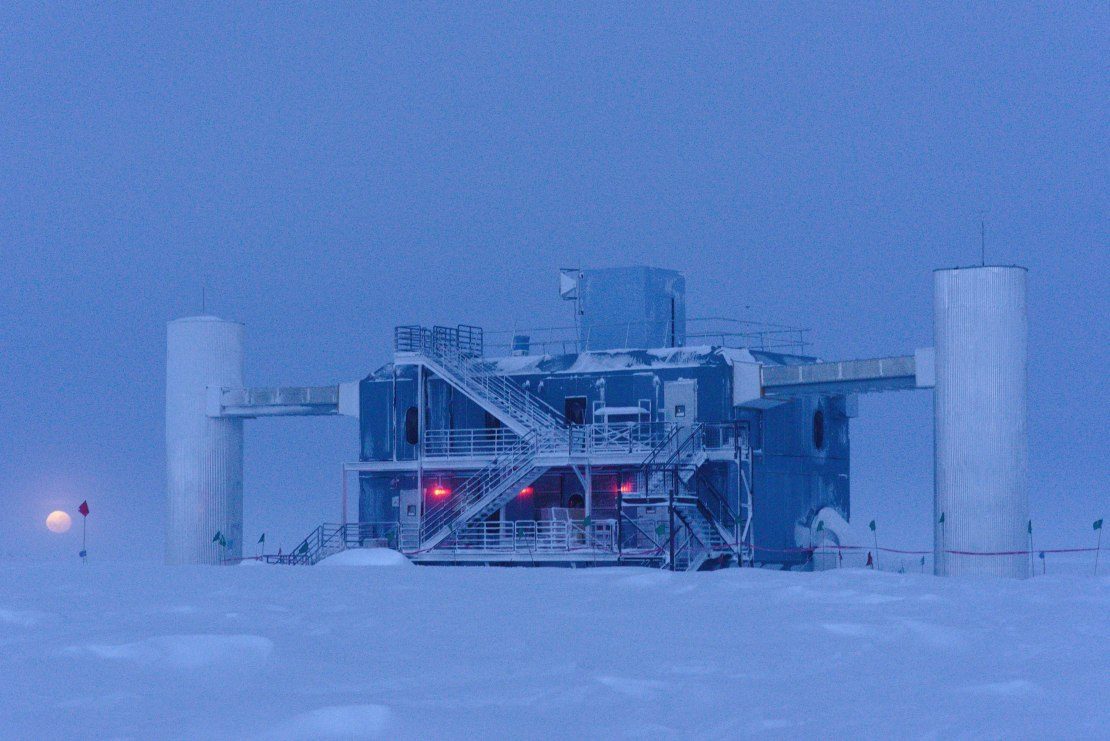
They created the IceCube Neutrino Observatory, a giant scientific instrument located near the South Pole.
IceCube contains 5,160 sensitive light detectors buried deep within approximately one cubic kilometre of ice.
These instruments do not take ordinary photographs of neutrinos. Instead, they search for tiny flashes of light.
When a neutrino occasionally interacts with matter, it can produce other fast-moving particles. Those particles sometimes create detectable light as they travel through the ice.
Think of it like discovering an invisible visitor by spotting the footprints it leaves behind!
Messages from Distant Galaxies
Why would scientists go to so much trouble to catch something almost invisible?
Because neutrinos can bring us messages from some of the most powerful places in the universe.
These include regions around giant black holes, where gravity is so strong that even light cannot escape from inside a special boundary called the event horizon.
Unlike ordinary light, neutrinos can travel through thick clouds of matter and carry clues about distant cosmic events.
In 2013, IceCube scientists announced evidence of extremely energetic neutrinos arriving from beyond our solar system.
In 2018, researchers linked a detected neutrino to activity in a distant galaxy containing an energetic black hole.
Then, in 2023, scientists revealed something remarkable: a new picture of our own galaxy, the Milky Way, created using high-energy neutrinos!
Why Is Francis Halzen Important?
Francis Halzen is one of the pioneering scientists behind IceCube. His work helped transform a daring idea into an extraordinary observatory capable of exploring space in a completely new way.
His achievements also show the importance of teamwork. Hundreds of scientists, engineers, and technicians from around the world helped build and operate IceCube.
What Could Scientists Discover Next?
Scientists continue improving IceCube so it can detect neutrinos more precisely and help answer questions about the universe.
Could ghost particles reveal how powerful cosmic explosions happen? Could they help us understand distant galaxies and black holes?
Researchers are working to find out!
The biggest lesson? Sometimes, to explore the mysteries of the sky, scientists must look deep beneath their feet.
✨ Did You Know?
📖 Science Word
Neutrino
/new-TREE-noh/A tiny particle with almost no mass and no electric charge that can travel through enormous amounts of matter without interacting.
🔤 Word Scramble
Test Yourself! Can You Solve the Ghost Particle Mystery?
Question 1 of 5
Which scientist helped pioneer the IceCube Neutrino Observatory?
Quick Poll
If you became a space scientist, which cosmic mystery would you most want to solve?
How fun was this article?