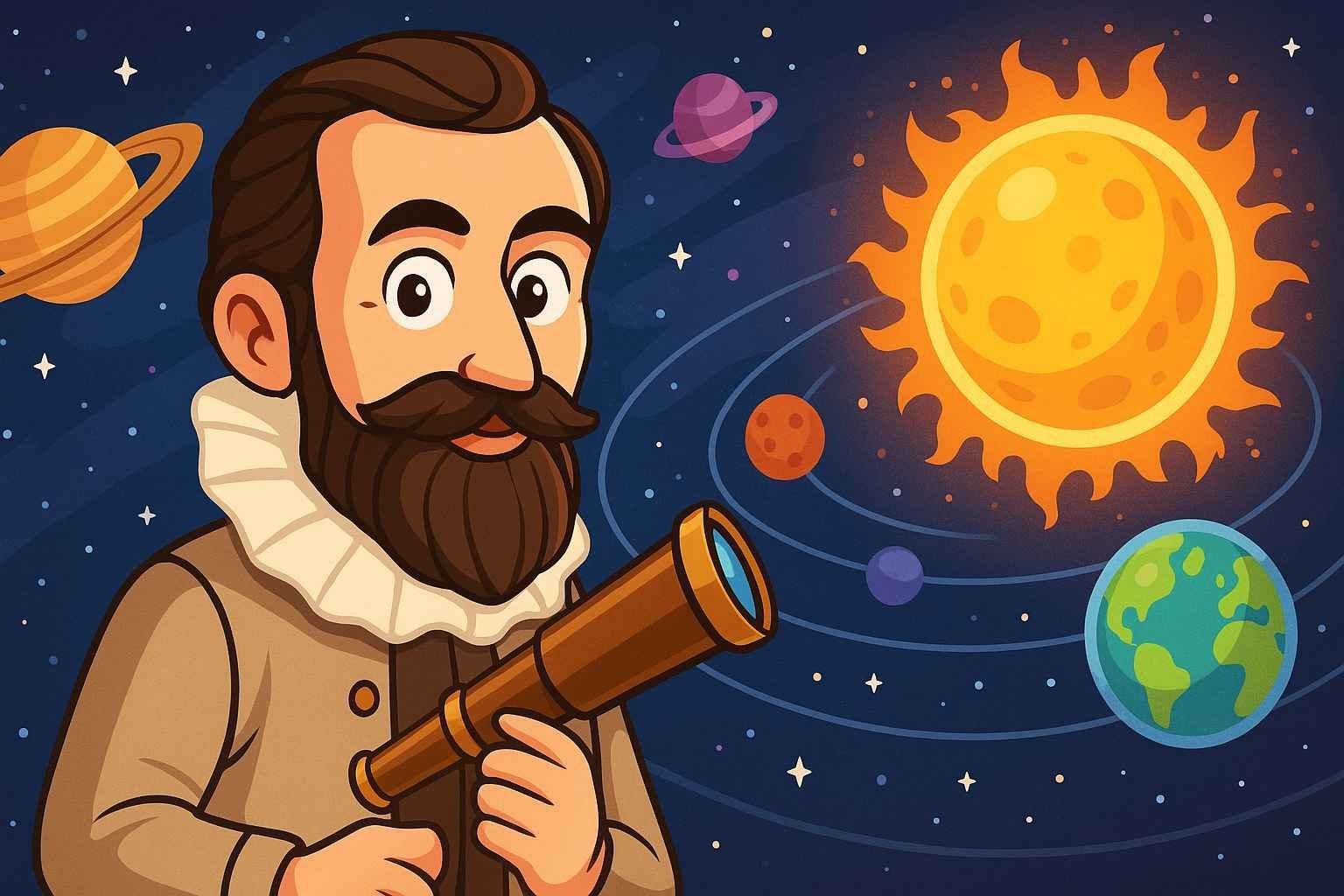
Johannes Kepler for Kids: The Astronomer Who Explained Planetary Motion 🌍✨
The Sky Detective Who Solved Planetary Puzzles: How math and patience revealed the orbital dance of our solar system.
Discover the amazing story of Johannes Kepler, the astronomer who explained how planets move around the Sun. A fun, kid-friendly science article filled with simple explanations, cool facts, and interactive activities!
Introduction: The Sky Detective Who Solved Planetary Puzzles 🔎🌌
Long before rockets, telescopes, and space stations, one brilliant scientist looked up at the night sky and asked a bold question:“How do planets really move around the Sun?”
His name was Johannes Kepler, and he became the astronomer who finally explained the beautiful, mysterious dance of the planets — changing astronomy forever!
🌟 Early Life: A Curious Boy Who Loved the Stars
Johannes Kepler was born in 1571 in Germany. He was a small, sickly child, and often couldn’t run or play like other kids. But what he could do was observe — and he loved looking at the Moon, stars, and comets.
When Johannes was six, something magical happened:His mother took him outside to watch a bright comet streak across the sky! ☄️This moment filled young Kepler with wonder and became the spark that lit his lifelong passion for astronomy.
🔭 Working With the Best Telescope on Earth (But Not His!)
As an adult, Kepler became an excellent mathematician. He later joined the famous astronomer Tycho Brahe, who owned the world’s most powerful observing instruments (before the invention of telescopes!).
Tycho observed the skies.Kepler did the calculations.Together, they became an unstoppable team!
When Tycho passed away, Kepler inherited his enormous collection of star and planet data — like a cosmic treasure chest.And Kepler was ready to solve the greatest mystery of all…
🌍 Kepler’s Big Discovery: Planets Don’t Move in Circles! 😲
For thousands of years, people believed that planets traveled in perfect circles.But Kepler discovered something shocking:
Planets move in OVAL paths called “ellipses.”
This became Kepler’s First Law of Planetary Motion — and it changed our understanding of the solar system.
Then he discovered more:
🪐 Kepler’s Second Law:
Planets move faster when they’re closer to the Sun and slower when they’re farther away.
🌟 Kepler’s Third Law:
There is a clear mathematical pattern in how long each planet takes to orbit the Sun.
Kepler’s discoveries proved that the solar system follows mathematical rules, not guesswork — a huge step for science!
😮 Fun Fact: Kepler Wanted to Be a Space Story Writer!
Kepler wrote one of the world’s first science-fiction stories about traveling to the Moon.He imagined strange creatures and powerful winds that pushed travelers into space! 🌕🚀
He was not only a scientist…He was a dreamer, too. ✨
💫 How Kepler Changed the World
Kepler’s ideas paved the way for:
Any spacecraft that travels to Mars or studies other planets must follow Kepler’s laws — even 400 years later!
🤔 DO YOU KNOW? Fun Facts About Kepler
🎮 Interactive Zone: Become a Mini Kepler!
Quiz Time! 📝
1️⃣ What shape do planets move in?A) Perfect circlesB) SquaresC) Ellipses (Correct)
2️⃣ Who helped Kepler with star observations?A) Tycho Brahe (Correct)B) GalileoC) Einstein
3️⃣ What speeds up a planet’s movement?A) Being close to the Sun (Correct)B) Being far awayC) Being cold
Try It Yourself! 🪐
Take a piece of string and two push pins.Stick the pins into paper and loop the string around them.Pull the string tight with a pencil and draw a shape.That is an ellipse — just like a planet’s orbit!
Poll for Kids 🌟
If you could discover something in space like Kepler, what would it be?
🌈 Conclusion: Kepler’s Curiosity Lights the Way
Johannes Kepler proved that even the biggest mysteries can be solved with patience, math, and imagination.
He turned the sky’s hidden patterns into scientific laws that guide today’s astronauts and space missions.
So the next time you look up at the stars…Remember the man who figured out how everything up there moves.A true cosmic detective! 🌌🔍✨
✨ Did You Know?
📖 Science Word
Ellipse
/ee-LIPS/A regular oval shape traced by a point moving in a plane so that the sum of its distances from two fixed points (foci) remains constant.
🔤 Word Scramble
Test Yourself!
Question 1 of 4
What geometric shape did Johannes Kepler discover planetary orbits take in his First Law of Planetary Motion?
Quick Poll
Which of Kepler's astronomical achievements do you find most impressive?
How fun was this article?