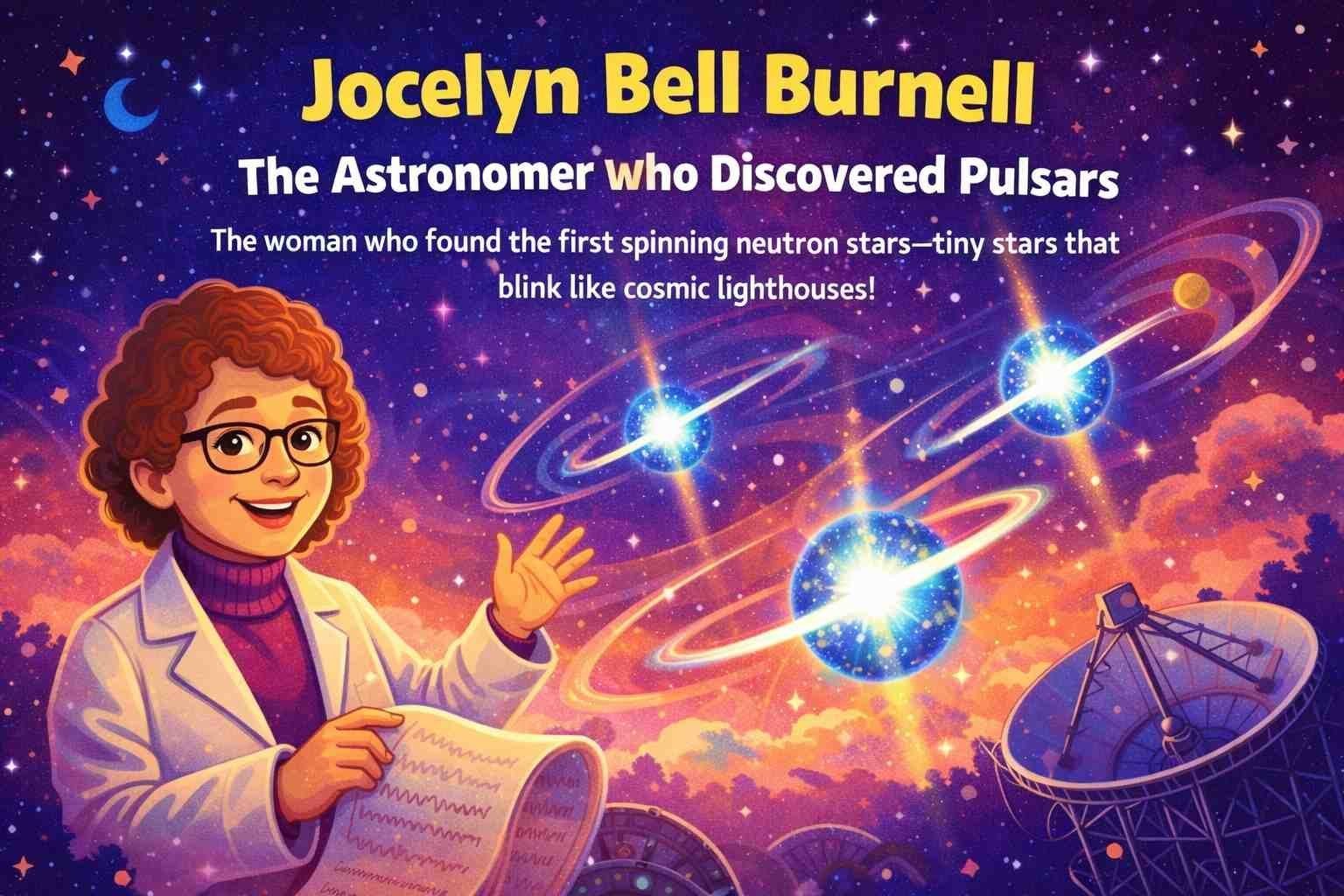
Jocelyn Bell Burnell for Kids: The Astronomer Who Discovered Pulsars 🌌✨
The Girl Who Heard the Universe Blink: How careful observation revealed cosmic lighthouses.
Discover the inspiring story of Jocelyn Bell Burnell, the astronomer who discovered pulsars—tiny spinning neutron stars that blink like cosmic lighthouses. A fun, kid-friendly space science article with stories, facts, and quizzes!
Introduction: The Girl Who Heard the Universe Blink 👂🌠
Imagine listening to space… and suddenly hearing a strange blink… blink… blink coming from the stars!
That’s exactly what happened to Jocelyn Bell Burnell, an astronomer who discovered one of the most mysterious objects in the universe—pulsars. These are tiny, super-dense stars that spin fast and send signals through space like cosmic lighthouses! 🌀💫
Her discovery changed astronomy forever—but her story also teaches kids about curiosity, courage, and not giving up, even when others don’t listen.
🌱 Early Life: A Curious Girl Who Loved Questions
Jocelyn Bell Burnell was born in 1943 in Northern Ireland. When she was a child, many people believed girls shouldn’t study science. Some schools even tried to keep girls out of advanced science classes.
But Jocelyn loved asking questions like:
Her parents supported her curiosity, and she kept studying science—no matter what anyone said. 🌟
📡 Building a Giant Space Ear
As a young scientist, Jocelyn worked on a huge project at university. She helped build a massive radio telescope—made of wires and poles—that could listen to radio signals from space.
She carefully checked miles of paper charts every day, looking for unusual signals. Most people would have missed them… but Jocelyn noticed something strange.
There was a signal that blinked:
She knew this wasn’t normal.
🌌 The Big Discovery: Pulsars!
At first, no one knew what the signal was. Some scientists even joked that it might be aliens! 👽😄
But Jocelyn kept investigating. She discovered that the signal came from a neutron star—the leftover core of a giant star that had exploded.
These neutron stars spin incredibly fast and send out beams of energy. When the beam points toward Earth, we see a pulse—just like a lighthouse flashing at sea.
These objects were named pulsars.
🌟 This was one of the greatest discoveries in modern astronomy.
😔 A Hard Moment—and a Powerful Lesson
Although Jocelyn discovered pulsars, she did not receive the Nobel Prize for the discovery. Instead, it was awarded to her supervisor.
Many people later said this was unfair. But Jocelyn showed amazing strength. She didn’t quit science. She didn’t stop believing in herself.
Instead, she became a leader who worked to:
🌍 Why Pulsars Matter
Thanks to pulsars, scientists can:
Today, pulsars help scientists understand black holes, galaxies, and even how time works in the universe!
🤔 DO YOU KNOW? Fun Facts About Jocelyn Bell Burnell
🎮 Interactive Fun Zone
🧠 Quick Quiz
1️⃣ What did Jocelyn discover?A) PlanetsB) Pulsars (Correct)C) Comets
2️⃣ What are pulsars compared to?A) Space enginesB) Cosmic lighthouses (Correct)C) Shooting stars
3️⃣ What kind of telescope did she use?A) Optical telescopeB) Radio telescope (Correct)C) Space rocket
🔍 Think Like Jocelyn!
Imagine you notice something strange that others ignore. What would YOU do?
That’s how real science works!
🌈 Conclusion: Listening Carefully Can Change the World
Jocelyn Bell Burnell showed the world that big discoveries can come from careful listening and brave thinking.
Her story reminds kids that:🌟 You don’t have to be loud to be powerful🌟 You don’t have to be famous to be important🌟 If you notice something unusual—pay attention!
Because the universe might be trying to tell you something. 🌌✨
✨ Did You Know?
📖 Science Word
Pulsar
/PULL-sar/A rapidly rotating, highly magnetized neutron star that emits focused beams of electromagnetic radiation out of its magnetic poles.
🔤 Word Scramble
Test Yourself!
Question 1 of 4
What is a pulsar in astronomical science?
Quick Poll
Which aspect of Jocelyn Bell Burnell's journey inspires you most?
How fun was this article?