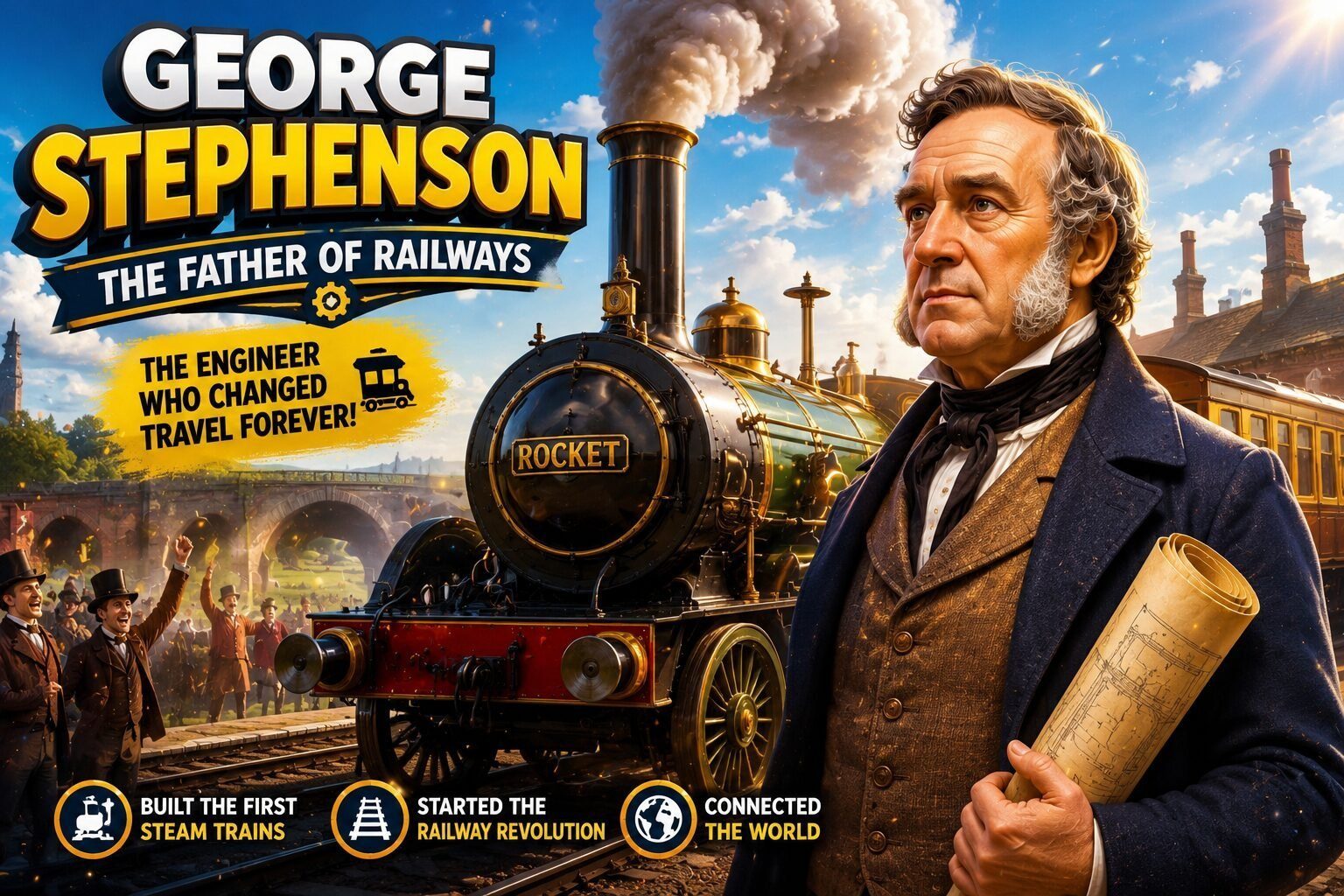
George Stephenson: The Father of Railways 🚂⚙️
The Man Who Changed Travel Forever: Discover how steam locomotives replaced horse wagons and connected the world.
The Man Who Changed Travel Forever 🚂🌍
Imagine a world without trains. No fast railway journeys, no giant engines pulling long lines of cars, and no quick way to travel across countries. Long ago, most people traveled slowly by horse or wagon.
Then came George Stephenson, the engineer who helped create the world’s first successful steam-powered railways!
Meet the inventor who helped launch the railway revolution and made travel faster than ever before. 🚂✨
🌱 Early Life: A Curious Boy Who Loved Machines
George Stephenson was born in 1781 in England. His family was poor, and as a child he did not get much schooling.
But George was extremely curious about machines. He loved watching engines work and wanted to understand how they moved.
As a young boy, he:
Even without a fancy education, his determination helped him become a brilliant engineer.
⚙️ The Power of Steam
During George Stephenson’s time, steam engines were already being used in mines. But they were slow and not very useful for carrying people long distances.
George believed steam engines could do much more.
He worked hard to improve them by making:
Soon, he began building powerful steam locomotives.
🚂 The First Great Locomotive
One of George Stephenson’s most famous trains was called Locomotion No. 1.
In 1825, it became the first steam locomotive to carry passengers on a public railway.
People were amazed! 😲 The train moved much faster than horses and could carry heavy loads easily.
Soon after, George created another famous locomotive called Rocket, which became one of the most successful early steam trains ever built.
🌍 Starting the Railway Revolution
George Stephenson helped build railways across England, and soon trains spread around the world.
Railways changed life forever by:
Because of his achievements, George became known as:
🚂 “The Father of Railways”
🧠 Smart Engineering Ideas
George Stephenson didn’t just build trains—he also improved railway systems.
One of his important ideas was the standard railway gauge, which means keeping tracks the same width so trains can travel smoothly across different railways.
Many railways today still use measurements based on his system!
🤔 DO YOU KNOW? Fun Facts About George Stephenson
🎮 Interactive Fun Zone
🧠 Quick Quiz
1️⃣ What is George Stephenson famous for?A) Inventing airplanesB) Building steam trains (Correct)C) Discovering electricity
2️⃣ What was one famous locomotive he built?A) ApolloB) Rocket (Correct)C) Voyager
3️⃣ Why were railways important?A) They made travel faster (Correct)B) They cooled homesC) They created rain
🔍 Think Like an Engineer!
If you could invent a new type of transport, what would it be?
Big inventions begin with imagination!
🌈 Conclusion: The Engineer Who Connected the World
George Stephenson helped change transportation forever. His steam-powered trains made travel faster, easier, and more exciting for millions of people.
🌟 His story teaches kids:
So the next time you see a train rushing down the tracks, remember the engineer who helped start the railway revolution! 🚂✨
✨ Did You Know?
📖 Science Word
Locomotive
/loh-kuh-MOH-tiv/A powered rail vehicle designed specifically to pull or push trains of unpowered passenger carriages or freight cars along a track.
🔤 Word Scramble
Test Yourself!
Question 1 of 4
Which historic 1825 railway line featured Stephenson's Locomotion No. 1 as the first public steam passenger train?
Quick Poll
Which aspect of early steam train development do you find most incredible?
How fun was this article?