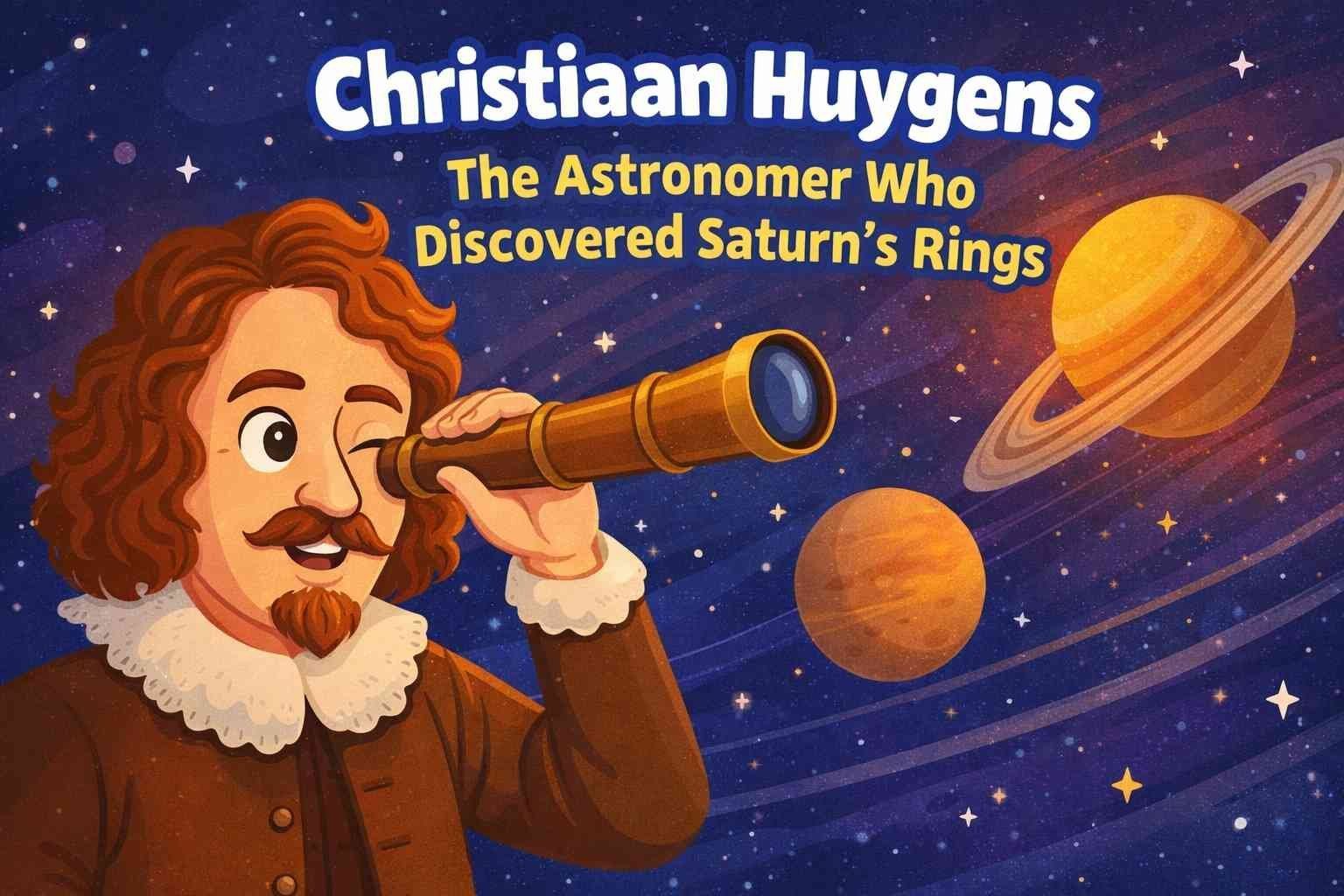
Christiaan Huygens for Kids: The Astronomer Who Discovered Saturn’s Rings 🪐🔭
The Man Who Solved Saturn’s Biggest Mystery: Unveiling cosmic rings, Titan, and precision clocks.
Discover the amazing story of Christiaan Huygens, the astronomer who explained Saturn’s rings and discovered its moon Titan. A fun, kid-friendly space science article with facts, quizzes, and easy explanations!
Introduction: The Man Who Solved Saturn’s Biggest Mystery 🌟
Long ago, when telescopes were new and space was full of secrets, one planet confused everyone—Saturn. People saw strange shapes around it and thought it had “ears” or “handles”! 😮
Then came a brilliant scientist named Christiaan Huygens, who used careful thinking and a powerful telescope to reveal Saturn’s true beauty—its rings—and even discovered one of its most mysterious moons, Titan.
🌱 Early Life: A Curious Boy Who Loved Math and the Sky
Christiaan Huygens was born in 1629 in the Netherlands. He grew up in a well-educated family, and from a young age, he loved numbers, puzzles, and astronomy.
While other kids played games, Huygens enjoyed solving math problems and learning how the universe works. His curiosity pushed him to study science deeply—and it paid off! 🌟
🔭 Building Better Telescopes
During Huygens’ time, telescopes were still very basic. Christiaan and his brother decided to build their own improved telescopes, grinding lenses by hand to make them clearer and stronger.
With these better telescopes, Huygens could see farther and sharper into space than most people of his time. And that’s when he noticed something amazing about Saturn…
🪐 The Big Discovery: Saturn’s Rings Explained
Before Huygens, astronomers couldn’t understand Saturn’s strange shape. Some thought it had arms, others thought it was breaking apart!
Huygens carefully observed Saturn over many months and realized the truth:
👉 Saturn is surrounded by a thin, flat ring that doesn’t touch the planet.
This was a huge discovery and finally explained Saturn’s mystery. Today, we know Saturn has thousands of rings, made of ice and rock—but Huygens was the first to understand their real nature!
🌕 Discovering Titan: Saturn’s Giant Moon
In 1655, Huygens made another incredible discovery—Titan, Saturn’s largest moon.
Titan is special because:
All of this began with Huygens’ careful observation over 350 years ago.
⏰ More Than an Astronomer
Christiaan Huygens wasn’t just a space scientist. He also:
He believed the universe followed clear laws, and science was the key to understanding them.
🤔 DO YOU KNOW? Fun Facts About Christiaan Huygens
🎮 Interactive Fun Zone
Quick Quiz 📝
1️⃣ What planet did Huygens study closely?A) MarsB) Saturn (Correct)C) Jupiter
2️⃣ What did Huygens discover around Saturn?A) CloudsB) Rings (Correct)C) Mountains
3️⃣ What is Titan?A) A starB) A cometC) Saturn’s moon (Correct)
Try This at Home 🪐
Cut a paper circle and place a thin paper ring around it.Spin it gently on a table—this helps you imagine how Saturn’s rings orbit the planet!
Kids Poll 🌟
If you could visit Saturn, what would you explore first?
🌈 Conclusion: A Mind That Revealed Cosmic Beauty
Christiaan Huygens showed the world that patience, careful observation, and curiosity can solve even the biggest mysteries of space.
Every time scientists study Saturn’s rings or explore Titan, they follow the path Huygens started long ago.
So next time you see a picture of Saturn glowing in space, remember the man who revealed its beauty to the world—Christiaan Huygens, the astronomer who saw clearly when others could not. 🌌🔭✨
✨ Did You Know?
📖 Science Word
Planetary Ring
/PLAN-ih-tair-ee RING/A broad, flat disk of orbiting cosmic debris—consisting primarily of ice particles, dust, and rock boulders—encircling a planet.
🔤 Word Scramble
Test Yourself!
Question 1 of 4
What did Christiaan Huygens deduce about the mysterious 'handles' seen around Saturn?
Quick Poll
Which of Christiaan Huygens' achievements impresses you the most?
How fun was this article?